

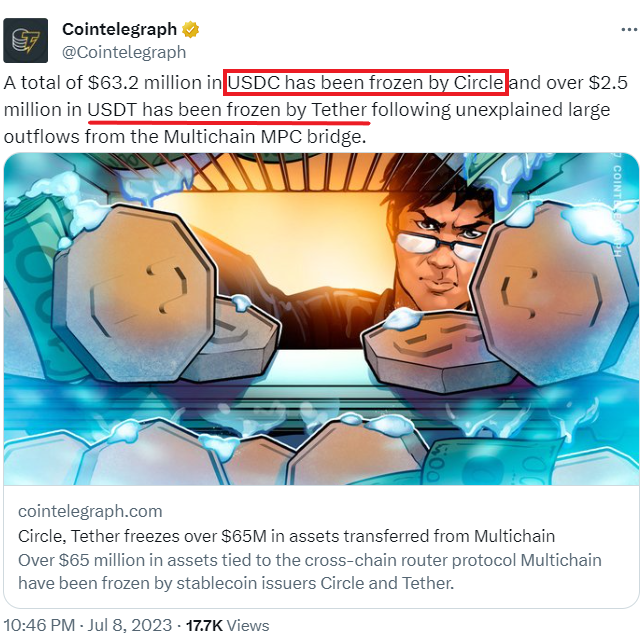
Did you know the Government can freeze your crypto in your hardware wallet and make it unusable, if it doesn’t like what you say or do? This happened in 2022 to the Canadian Freedom Convoy Truckers that were protesting. We also see USDT and USDC issuers constantly freezing crypto that hackers have stolen. There is a saying, not your keys, not your coins. There should be another saying, your keys, your coins — but only if the government likes you.
So make sure you are using multiple different wallets. Even better, use a separate wallet, for each crypto exchange you use. In order to freeze your crypto, they have to know where it is. So if you are using multiple wallets, it will make it harder (not impossible) for someone to find it all. This way, if the Government doesn’t like your social media post, at least all your crypto isn’t frozen, all at once.
There is a myth out there that only crypto on a centralized exchange like Coinbase or Binance can be frozen when the Government asks the exchange. But in reality it goes far beyond that. The government can ask the Crypto issuer like Tether or Circle to freeze the crypto coins themselves. They can also ask all the exchanges to Blacklist specific wallet addresses, so that people are unable to transfer their crypto to an exchange. There is also a concept called Tainted Crypto. The government can basically make an imprint or a tatoo on a crypto it deems stolen/hacked. And this crypto will forever hold that tainted mark on it — no matter where it’s transferred.
https://archive.ph/Nqh8F
7/8/23
Circle, Tether freezes over $65M in assets transferred from Multichain
Stablecoin issuers Circle and Tether have frozen over $65 million in assets tied to the suspected exploit of cross-chain router protocol Multichain. The move follows unexplained large outflows from the Multichain MPC bridge on July 6.
According to the knowledge graph protocol 0xScope, three addresses that received at least $63.2 million in USD Coin (USDC) from Multichain are now frozen. Another report from the Fantom Foundation notes that more than $2.5 million in Tether (USDT) had also been frozen from two addresses listed by Etherscan as “Multichain Suspicious Addresses”.
https://thebitcoinmanual.com/articles/what-is-tainted-bitcoin/
Tainted Bitcoin is a concept of tagging bitcoin associated with the illicit activity as “dirty” and that the tagging will continue indefinitely on that bitcoin despite it being transferred and changing ownership.
If authorities do enforce these tainted blacklists, the concern is that individuals might unknowingly receive tainted bitcoin, through no fault of their own, and might have their funds seized and accounts blocked should they move it to a centralised authority where you give up custody like an exchange. Alternatively, selling the coins is subject to increased scrutiny before they can make a payment, with a merchant accepting bitcoin as payment.
https://coinmarketcap.com/alexandria/article/how-can-cryptocurrencies-be-frozen-on-a-blockchain
How Can Cryptocurrencies Be Frozen on a Blockchain?
You might be surprised to find out that not only is it technically feasible to freeze assets held in an external wallet, but also relatively common.
Contrary to how it might feel when interacting with them, ERC-20 tokens are simply a reference to a database that keeps track of which address holds what number of units of said token. The token contract is responsible for managing this database. When tokens are transferred from one person to another, the contract is responsible for changing the number of tokens associated with each address — deducting the sum from one address and adding it to another to ensure the supply remains constant.
Because this token contract is usually the only smart contract with the authority to modify the token holder database, it can be used to block access to funds, confiscate tokens or, in some cases, even burn the tokens entirely.
If an address is blacklisted by the smart contract, then it may be unable to buy (or receive) and sell (or send) the token. Only an admin address will be able to update the smart contract with a blacklisted address.
Tether (USDT) is one such token with these capabilities. The USDT smart contract has the capability of freezing and reissuing USDT.
It isn’t just Ethereum-based token contracts that might have freeze, blacklist and confiscation capabilities either. Most layer-1 blockchains have this functionality built in as a core feature of token contracts. This includes XRP and Stellar, both of which allow developers to issue tokens with a global freeze function — this allows the issuer to freeze token transfers.
That said, this ability to freeze generally applies only to tokens. Despite popular belief, it is not possible to freeze the native asset associated with most blockchains, such as BTC, ETH, BNB or XRP — unless they are held on a centralized platform, such as an exchange or with a custodian.
https://news.bitcoin.com/trudeaus-government-warns-more-accounts-will-be-frozen-freedom-convoy-truckers-hold-their-ground/
2/18/22
The Canadian government has warned that more financial accounts and cryptocurrency wallets will be frozen as law enforcement attempts to end the Freedom Convoy trucker protest. However, truckers are standing their ground even after the police arrested two protest organizers. Prime Minister Justin Trudeau says, “It’s high time that these illegal and dangerous activities stop.”
https://www.coindesk.com/policy/2022/02/16/canada-sanctions-34-crypto-wallets-tied-to-trucker-freedom-convoy/
2/16/22
Canada Sanctions 34 Crypto Wallets Tied to Trucker ‘Freedom Convoy’
The Ontario Provincial Police and Royal Canadian Mounted Police ordered all regulated financial firms to cease facilitating any transactions from 34 crypto wallets tied to funding trucker-led protests in the country.
https://www.coindesk.com/layer2/2022/02/22/frozen-bitcoin-tied-to-canadian-protests-lands-at-coinbase-cryptocom/
2/22/22
Unlike bank wires, transactions on decentralized blockchains typically cannot be stopped or frozen. An exception is when the smart contract for a non-native asset, such as an ERC-20 token on Ethereum, allows the issuer to freeze certain addresses and prevent any further transactions, as Tether, the issuer of the world’s largest stablecoin, USDT, has done several times.
On Feb. 16, Canadian police ordered that all regulated financial firms stop facilitating transactions for 34 wallets associated with the protestors (30 were bitcoin wallets and the rest held other cryptocurrencies). The police sent a letter to a number of banks and crypto exchanges, Canada’s The Globe and Mail reported, but didn’t specify which ones received the warning.
On Feb. 17, in a separate legal fight brought by locals affected by the protest, the Ontario Superior Court of Justice ordered that nine crypto platforms freeze accounts associated with 120 cryptocurrency addresses belonging to the movement. This means that if those platforms received funds from the listed addresses they should prevent any further movement of them. The list of addresses was provided via a Mareva injunction — a form of court-provided asset freezing.
https://www.cryptopolitan.com/cryptocurrencies-frozen-on-a-blockchain/
Coinbase — the exchange is no stranger to freezing accounts. In December 2020, it attracted the wrath of its customers. Then, many users accused it of freezing their accounts amid a Bitcoin bull run.
Binance — between late 2020 and mid this year, it froze the accounts of many of its global customers. The dev team didn’t explain the reasoning behind the act. Its May 2020 incident, however, coincided with the plummeting of BTC.
Index — the Indian exchange suspended user accounts for suspicious activity in January 2021. The said activities had peaked with BTC’s rallying at the time.
KuCoin — in late 2020 it froze user accounts to deal with a $150 million hack it had suffered.
https://www.foxnews.com/world/uk-police-british-army-veteran-arrested-anti-lgbtq-social-media-post-caused-anxiety-video
8/3/22
UK police say British Army veteran arrested because anti-LGBTQ social media post ‘caused anxiety’: video
https://www.dw.com/en/hong-kong-student-arrested-upon-return-from-japan-sparks-fears-over-security-laws-reach/a-65418216
4/24/23
Hong Kong student arrested over social media posts in Japan
https://xrpl.org/common-misconceptions-about-freezes.html#:~:text=XRP%20is%20the%20only%20native,by%20any%20entity%20or%20individual
It is a common misconception that Ripple or others can freeze XRP, similar to how centralized services like PayPal can suspend your account and prevent you from accessing your funds. In reality, while the XRP Ledger does have a freeze feature, it can only be used on issued tokens, not on XRP. No one can freeze XRP.
Tokens in the XRP Ledger are fundamentally different than XRP. Tokens always exist in trust lines, which can be frozen. XRP exists in accounts, which cannot be frozen.
https://news.bitcoin.com/ripple-gateways-can-freeze-users-funds-time/
The answer to Ripple’s capabilities lies in a document the company released in 2014 introducing Balance Freeze and stating:
Ripple’s Balance freeze protocol extension gives gateways the ability to…freeze funds issued to a particular user. Frozen funds may only be sent back to the gateway who issued them. The global freeze feature allows a gateway to freeze all balances issued by it.
https://stellar.org/community/faq
SDF is a non-profit organization that supports the growth and development of an open-source distributed ledger protocol called “Stellar” or the “Stellar network.” SDF: DOES NOT have the capability to freeze or return XLM held in a Stellar account.
 Prophetic Money