

Have you heard of Tainted Cryptos? Imagine you’re on pancake swap or the built-in Swap feature in your crypto wallet app, trading your BTC for Ethereum, and unknowingly, you receive Ethereum from a Crypto Hacker’s wallet. This hacker was involved in major crypto thefts around the world. And now because you received this “tainted” or flagged crypto, from the hacker, your wallet is also “tainted” now. Any exchange you interact with will assume that your crypto wallet is high-risk, because you interacted with the hacker, and your crypto was involved in crypto theft. The exchange really doesn’t know, if you are the hacker, or the hacker’s friend, or a mule — assisting the hacker in order to cash out the stolen crypto. This is why using Centralized Exchanges (Coinbase, Kraken, Uphold, etc.), is much safer. Although, some articles say that even central exchanges sometimes don’t catch tainted cryptos and also trade them.
My recommendation is to use multiple wallets. Separate wallet for each exchange. And a separate wallet for any defi services like pancake swap, uniswap, etc. And don’t mix crypto between these wallets. We know that there are many complaints of Crypto exchanges blocking/revoking access to people without giving them any explanation. The three main reasons I’m aware of, for your crypto account to be closed, are sending crypto to high risk companies (gambling sites, marijuana dispensaries, firearms dealers, etc.), using crypto mixers like tornado cash, and dealing with high risk/tainted wallets (that have crypto linked to a theft/hack). So, diversification is the best remedy in my opinion. If for some reason your wallet gets flagged, at least you will still have crypto in other wallets that you can use.
https://youtu.be/6ClaprOJ5F4
BitCoin’s Fatal FLAW That Nobody’s Talking About (Fungibility, Tainted Coins)
1:13 – fungibility is officially defined, as the ability of a good or asset, to be interchanged with other individual goods or assets of the same type. think of a gold bar. you can take a gold bar and exchange it with another gold bar of the same mass. this new gold bar in theory, would not lose any value. it would be worth exactly the same as the first. fungibility implies that two things are identical in specification. where individual units can be mutually substituted. so you’re probably now thinking well bitcoin fits this description. i can trade one bitcoin for another and the value would obviously stay the same. there basically is only one price for bitcoin. turns out that’s actually not true at all. bitcoin as you will see in a minute is a non-fungible asset. but before i explain you have to understand another feature about bitcoin.
2:00 – bitcoin has something called public blockchain. think of this public blockchain as a public excel sheet, that contains every transaction involving bitcoin, since the start. in its most simple form, bitcoin is really just a list. person A, sent x bitcoin to person B, who sent y bitcoin to person C, etc. by tallying all these transactions up, everyone knows where individual users stand. this distributed ledger or list is available for all to see. anyone can download in its entirety, or go to any number of sites that parse it. so this is where things get interesting. when you receive a bitcoin you are likely not the first person to get it. it probably has a history where it exchanged hands going from person A, to person A, to person C, etc., before finally getting to you. so what about this makes it not fungible? well it starts with this idea of Virgin, versus Tainted, versus Regular bitcoin. At the end of the day bitcoin isn’t considered fungible, because it has different values, depending on which of these three categories it falls under. virgin bitcoin trades at the premium. and tainted bitcoin trades at a discount. virgin bitcoin which is bitcoin just mined fresh off the print, is very valuable. its transaction history is empty. now on the other side of that, we have tainted bitcoin. tainted bitcoin is bitcoin that has been through the hands of a nefarious organization, or people with illicit transaction history.
3:22 – so you may be wondering how anyone can determine what makes a bitcoin transaction illicit. and I had the same thought when i originally heard about this. turns out there is an entire industry dedicated to tracing and mapping bitcoin transactions, wallets, and other information related to illicit activity. one of those companies is chain analysis. and going to their website you can see they’re an entire organization, that is dedicated to blockchain analysis. providing data software services, and research, to government agencies, exchanges, financial institutions, and insurance, and cyber security companies.
3:59 – so why does this all matter to you? well you can actually receive a tainted bitcoin without knowing it. and the repercussions can be severe. just like when you receive a 100 bill in your hands. you don’t care that it was used to buy drugs, or weapons, in the transaction before you. or 10 transactions before you. nor do you check its serial number to ensure that it’s all clean. this concept applies to your bitcoin transactions as well. but unfortunately, large exchanges regulated by big government, and corporations, do care, in regards to bitcoin associated with past illicit activity. in fact, if you send bitcoin to a big exchange, and they happen to run analysis on it, and find that five hops ago, it was associated with something crazy, like terrorism or ransom payments, well there’s a very good chance, that that exchange confiscates that bitcoin, and will then require you to send in a long series of documents, to ensure you were clean, and unassociated. proving this is very difficult. and unfortunately this scenario does indeed happen all the time. just google tainted bitcoin, and you can read all the examples. Obviously, in order to prevent money laundering, terrorism, and other crimes, the U.S. and other large governments, are very interested in tracking bitcoin transactions. so while the concept of bitcoin has its origins in fighting against big government and regulation. the fact that there is a public spreadsheet of all transactions, makes it sort of attracting to intelligence agencies ,and other businesses, who can afford to map out wallets, and develop algorithms, that can indeed do a great job of spotting illicit activity. activity that may be traced back to you unfairly.
5:30 – you can see just how worried governments are regarding bitcoin, by seeing how they treat mixing services, which are essentially organizations that allow users to mix their coins, with other users. making it almost impossible to detect destination addresses. the department of justice, actually just arrested the operator of one of the world’s largest mixing services, Roman Sterlingov – a man who’s not even a U.S. citizen.
https://youtu.be/n0cpX0se6hI
Bitcoin’s fundamental flaw (Fungibility, Tainted Bitcoin)
1:43 – there are two concepts, that make bitcoin as a commodity, not fungible. that is, virgin bitcoin, and tainted bitcoin.
2:09 – different types of bitcoin are worth different prices. virgin bitcoin trades at a premium to regular bitcoin, and tainted bitcoin and trades at a discount, to regular bitcoin.
2:20 – a virgin bitcoin, is a bitcoin that was just recently minted by a miner. it has no transaction history.
3:12 – a tainted bitcoin is not a bitcoin that has a lot of transaction history. rather it is a bitcoin that has illicit transaction history. there are companies out there, like chain analysis, that surveil the public blockchain. and they have very smart people working on algorithms, to tag bitcoin outputs that they deem are high risk. meaning that they deem are part of illicit transactions.
4:49 – now, why should you care if you got tainted bitcoin? Well, if you send that tainted bitcoin to an exchange, and they run some sort of analysis on that bitcoin, on that output, see all the hops that it’s passed. well then they might arrive at a hop, that is tagged as illicit. at this point in time, this bitcoin was used to buy weapons, or drugs, or whatever. and the exchange will then confiscate your bitcoin, and require you to provide an onerous amount of documentation, proving who you are, and you are not that person, that 50 hops away, made that illicit transaction. which is virtually impossible. so that’s why tainted bitcoin is sold or is bought at a discount. because by using that tainted bitcoin, you run the risk of confiscation, at a centralized point. at a given third party like an exchange, like a custody solution, etc.
6:02 – i previously worked at a cryptocurrency company. before becoming a software developer. and i worked with – as part of being at that cryptocurrency company – various aml and kyc tools. like chain analysis. i’ve gone through the demos. i’ve seen the whole thing, how everything’s tracked, how everything’s tagged. and guys, there is no getting around it. using a mixer won’t help. using wasabi wallet won’t help. using coinjoin won’t help. the blockchain is public. coinjoin just adds a layer… false safety, false comfort
6:35 – chain analysis and other companies, see right through it. they write complex algorithms, to be able to tell, that you sent those bitcoins through all these different channels. mixing and matching, and back to yourself.
7:08 – monero, is a coin that is private by default. and has a various amount of built-in obfuscation techniques, that make it extremely difficult to track.
https://youtu.be/dJxnFle0HOk
Illegal activities in Crypto | What are tainted Coins?
0:30 – What are tainted coins? Because in Bitcoin and in any other blockchain, where you have a full transparent blockchain, you can see everything backward to what’s happening, you can actually connect coins that have been used for bad behavior. and these coins then become tainted coins. because no one wants them anymore.
https://youtu.be/X5-oaC52uoA
Fungibility: Bitcoin vs Privacy Coins | Privacy Coin Report
We’re diving into the world of cryptocurrency today, with a focus on fungibility. Now, you might be wondering, what is fungibility? Simply put, it’s the ability of a good or asset to be interchanged with other individual goods or assets of the same type. Think of it like this: if you lend a $10 bill to a friend, you don’t care if you don’t get the same exact bill back, because all $10 bills are worth the same. That’s fungibility.
Now, let’s talk about Bitcoin. Bitcoin is often considered fungible, but there’s a twist. Enter the concept of ‘Tainted Bitcoin.’ This refers to Bitcoins that are tracked and blacklisted due to their association with illegal activities. Because every Bitcoin transaction is permanently recorded on the blockchain, if a coin has been used for illegal purposes, it can be traced back.
So, how are these tainted Bitcoins identified? This is where blockchain analytics and machine learning come in. These technologies are used to analyze the Bitcoin blockchain, tracing the path of every coin and identifying any that have been involved in illegal activities.
Unfortunately, this process of tracing and blacklisting tainted Bitcoins can impact the fungibility of Bitcoin. If certain Bitcoins are considered less desirable because of their past, then all Bitcoins are not equal, and thus, not perfectly fungible. In addition to Bitcoin, all other transparent blockchains like Ethereum, Solana and Ripple are also susceptible to blockchain analytics and thus lack fungibility.
Why does this matter? Well, fungibility is a key characteristic of money. It’s what allows us to freely exchange money without concern for its past. If Bitcoin and other transparent blockchains can’t offer this, they face limitations as a form of currency.
This brings us to privacy coins, like Monero, Zcash, Pirate Chain, Conceal Network, and Ryo Currency. These cryptocurrencies are designed to be untraceable, preserving the fungibility that Bitcoin struggles with. While they have their own challenges, their focus on privacy and fungibility could make them better suited for use as a currency. But, as with all things in the world of cryptocurrency, only time will tell.
https://youtu.be/BILcJ3WtdLQ
Bitcoin Q&A: Blacklists, Taint, and Wallet Fingerprinting
3:15 – What does tainted mean? – tainted means that at some point in the last K number of transactions, those coins were involved in a coinjoin. what value are you going to give to that number K? so how many hops, or how many previous transactions are you going to look at? if you look back more than a dozen transactions, you’re going to run into something that’s tainted. which means that you can’t go that far back. if you’re in exchange, you can’t blacklist after 12 normal transactions, because, the thirteenth transaction in the past was a coinjoin. so if you have coinjoined coins, all you have to do is do 13 consecutive transactions to yourself. regular transactions, where you just bounce them from address, to address, to address, to address, to address, and then they’re no longer tainted. in general, when it comes to tainted coins, this mostly catches those who are unaware of these situations, involving with exchanges. because no matter how many hops they look back, all you have to do, is if they look at K hops back, you jump K plus 1. you create K plus-1 transactions to yourself, creating K plus 1 addresses. and the last one isn’t tainted. because the last K are not tainted. K plus-1 is tainted, but they’re not looking that far back. and if they keep increasing K, eventually they reach a point where everything’s tainted. and they can’t use that heuristic, because then they have to shut down their exchange.
https://www.youtube.com/watch?v=t9DsBhlWOlI
This is Why Exchanges Freeze Your Crypto
Shadow Atlas – Aug 6, 2025
They flag your coins before any crime has been proven. It’s based on suspicion. Basically, let’s be safe than sorry. And they use the method of heuristics, which is a fancy word for saying an educated guess. They scan a massive amount of blockchain data. They look for patterns and then an analyst is going to make a judgment call. But that’s all probability. It’s not certainty.
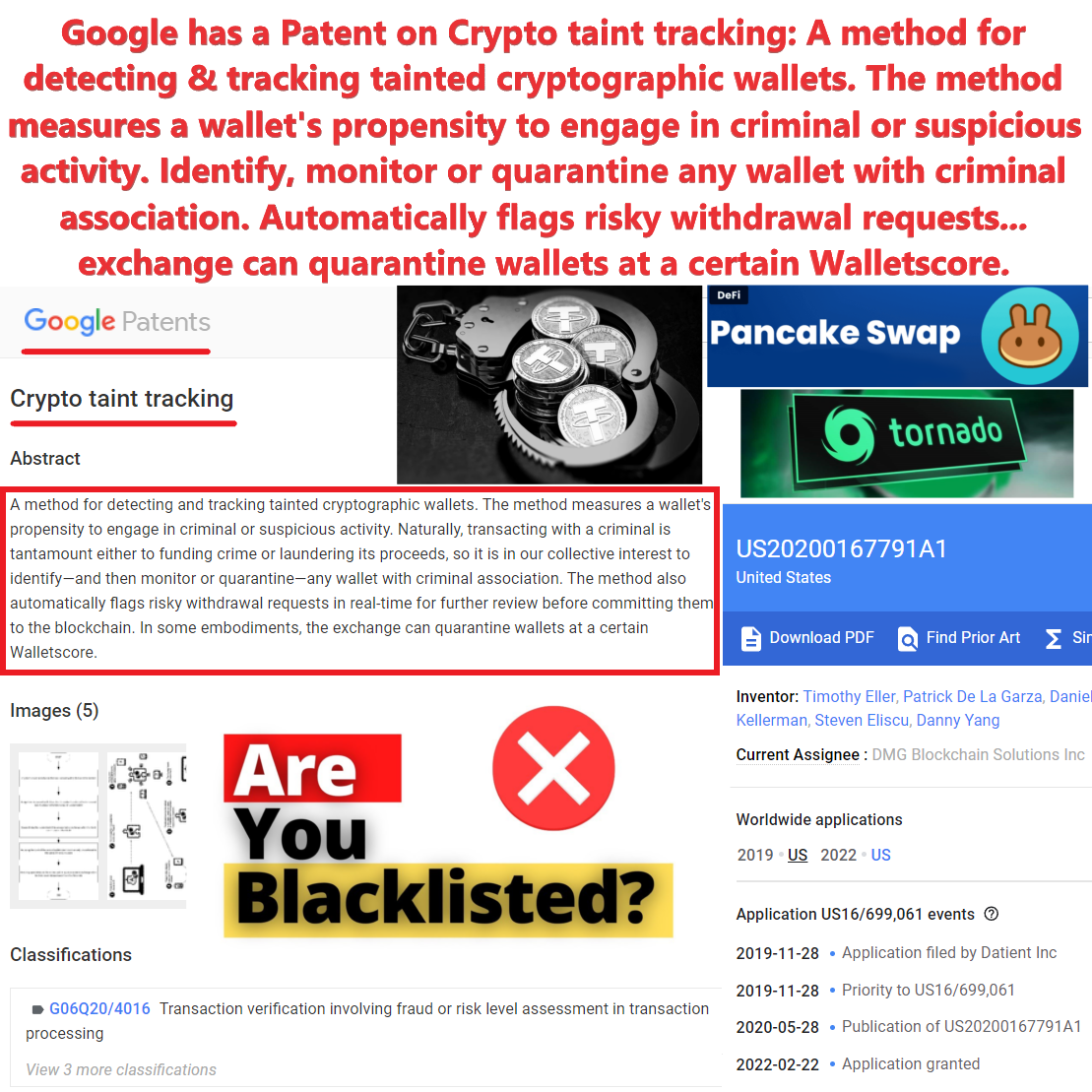
Google has a 2019 Patent for tracking tainted cryptos:
https://patents.google.com/patent/US20200167791A1/en
Crypto taint tracking A method for detecting and tracking tainted cryptographic wallets. The method measures a wallet’s propensity to engage in criminal or suspicious activity. Naturally, transacting with a criminal is tantamount either to funding crime or laundering its proceeds, so it is in our collective interest to identify — and then monitor or quarantine — any wallet with criminal association. The method also automatically flags risky withdrawal requests in real-time for further review before committing them to the blockchain. In some embodiments, the exchange can quarantine wallets at a certain Walletscore.
Here are a few articles on Tainted Cryptos:
Here is a Tainted Crypto Law that might get passed in Cook Islands (part of New Zealand):
https://www.1news.co.nz/2024/04/14/spy-film-type-thing-alarm-grows-over-cook-islands-cryptocurrency-bill/
‘Spy film type thing’ — Alarm grows over Cook Islands cryptocurrency bill
By Barbara Dreaver, Pacific Correspondent
Sun, Apr 14
Alarm is growing over proposed Cook Islands legislation, drafted by a US-based company, which could validate hacking into any account or system in the world.
In an investigation, 1News has learned that Drumcliffe, a high-value debt collector specialising in international asset seizure, hired at least two Cook Islands-based lawyers to draft the Tainted Cryptocurrency Recovery Bill 2023.
How does it work?
The Tainted Cryptocurrency Recovery Bill allows for “recovery agents” to use a variety of means including hacking to investigate and find cryptocurrency that may have been used for illegal means or is the proceeds of crime.
Suspected international assets would be seized and eventually turned into cash.
That cash would be put into a bank account in the Cook Islands and while there is little detail on where it would go from here, there would supposedly be some form of revenue stream and benefits to the Cook Islands economy.
The bill is so broadly written that anyone who is suspected of having or even suspected that they might have tainted cryptocurrency in the future can be hacked and spyware installed. Nijsse said he had never seen anything like it.
Given that the Cook Islands is a realm country of New Zealand, he said our Government should be very concerned as “it does have implications for New Zealand governance arrangements”.
But a number of experts say seizing the supposedly tainted cryptocurrency is not an easy thing to do. Jeff Nijsse said any seizures, that have been seen, have been as a result of people cooperating with law enforcement to hand over passwords and private keys.
https://web.archive.org/web/20230503133109/https://quantoz.com/publications/tainted-cryptocurrency-or-suspicious-transaction/
What is a tainted cryptocurrency?
The term tainted cryptocurrency implies that the cryptocurrency was used for illicit activities. Due to the nature of the blockchain technology and its electronic ledger, all transactions that ever have been made on the blockchain are traceable, forever. This might concern individuals that they hold cryptocurrencies that are ‘dirty’.
There are plenty of examples how cryptocurrencies could be tainted without any knowledge or blame to the holder of the crypto.
https://link.springer.com/article/10.1007/s10207-023-00766-z
2.1 Taint analysis
Taint in cryptocurrency refers to the concept that certain coins can be deemed riskier or less acceptable because of their previous owners’ possible links to criminal activity. In this regard, taint analysis can inform us of how much of a coin comes from a given address and thus what percentage of a coin can possibly have illegal or uncertain origins associated with criminal activities.
https://randomoracle.wordpress.com/2022/12/28/the-myth-of-tainted-blockchain-addresses-part-i/
Once we decide one pool of funds are tainted by virtue of being associated with a bad actor or event — a scam, rug-pull or garden-variety theft — that association propagates unchecked and continues to taint funds belonging to innocent bystanders who were not in any way involved with the original crime.
That raises the question: are these unwitting recipients also in violation of OFAC sanctions? Are all funds in those wallets now permanently tainted because of an inbound transaction, a transaction they neither asked for or had any realistic means to prevent given the way blockchains operate?
https://thebitcoinmanual.com/articles/what-is-tainted-bitcoin/
Tainted Bitcoin is a concept of tagging bitcoin associated with the illicit activity as “dirty” and that the tagging will continue indefinitely on that bitcoin despite it being transferred and changing ownership.
If authorities do enforce these tainted blacklists, the concern is that individuals might unknowingly receive tainted bitcoin, through no fault of their own, and might have their funds seized and accounts blocked should they move it to a centralised authority where you give up custody like an exchange. Alternatively, selling the coins is subject to increased scrutiny before they can make a payment, with a merchant accepting bitcoin as payment.
https://cryptoforensic.com/blog/tainted-bitcoin-isnt-what-you-think-it-is/
Tainted Bitcoin Isn’t What You Think It Is
If I Can’t be Certain Whether or Not I Have Tainted Bitcoin, is it Something I Need to be Concerned About?
The vast majority of people do not hold any tainted Bitcoin. Just as importantly, though, the vast majority of cryptocurrency users need not have any concern about whether or not they have tainted Bitcoin. This is because most users only buy from major exchanges and services. If you’re the type of person that only buys from these exchanges and major services, you have effectively zero risks you obtained any Bitcoin that was tainted.
__________________________________________________________________
Also, check out my post on how government can freeze your crypto in your hardware wallet and make it unusable, if it doesn’t like what you say or do: https://www.youtube.com/post/UgkxjkADKIP2l4xrC5IS6sgo0OxhmAmUVHBN
 Prophetic Money
great post
thank you
This is a lot to read but surely there must be a way to prove the innocent person was not involved with t the hacking surely if that person saved all their transactions there must be clear evidence that they were not directly involved in any hacks or money laundering schemes there should be a good practical way to provide this evidence I don’t like this at all this all about stealing innocent people crypto and wealth
make sure to read part 2 that I posted. Banks are pushing forward with this even more now. Bank of International Settlements has provided an update in August 2025 regarding how they wan to track and stop tainted wallets from cashing out crypto.
unfortunately if you want to protect yourself you need to start learning about this, regardless of how much time it takes to read. 😉
Warning!!! Have you heard of Tainted Cryptos? Part 2
https://propheticmoney.com/warning-have-you-heard-of-tainted-cryptos-part-2/
there have been a lot of complaints online over the years of exchanges freezing people’s account for almost no reason, and sometimes even shutting them down. and often it would take months and months of going back and forth and waiting, for the customer to finally get their funds unlocked. so one of the issues is the slow customer service response with this whole thing. so you are right in the sense that, yeah, you could probably provided proof and maybe that will be enough. but how long will your stuff be frozen before it’s finally unlocked. so ask yourself is it really worth the hassle. don’t use defi unless you really have to.
the governments don’t like people using DEFI so this is their intentional fight against DEFI. the best thing you can do if you want to stay safe is not use DEFI or in-wallet swaps. in part 2 i included the full PDF document the BIS posted with details on how they want to implement this tainted crypto compliance and which wallets they want to stop from cashing out.
a few years back there was a push against privacy coins like Monero. there’s a lot of article explaining how exchanges now treat customers who transfer privacy coins like they might be criminals, often freezing their funds, and asking for more documentation. because the government has been pressuring crypto exchanges, in their efforts in dealing with terrorism, and cyber theft. their thinking is that why would a normal person need to use these coins – only criminals that are hiding something have a need for them. and so anyone using them is now under suspicion. so governments attacking privacy coins and defi is not anything new, and is only going to get worse, in my opinion.
if you need to you can still use defi and pancake swap – but only with separate wallets. have a specific wallet for pancakeswap and don’t mix that crypto with any other crypto you have – or make any transcations to your other wallets. so that if you accidentally do received tainted crypto, there is no connection from your tainted wallet to your other wallets.
[…] sure you check out my previous warning post regarding Tainted Crypto here.
WordPress: https://propheticmoney.com/warning-have-you-heard-of-tainted-cryptos-prophetic-money/
YT post: […]