

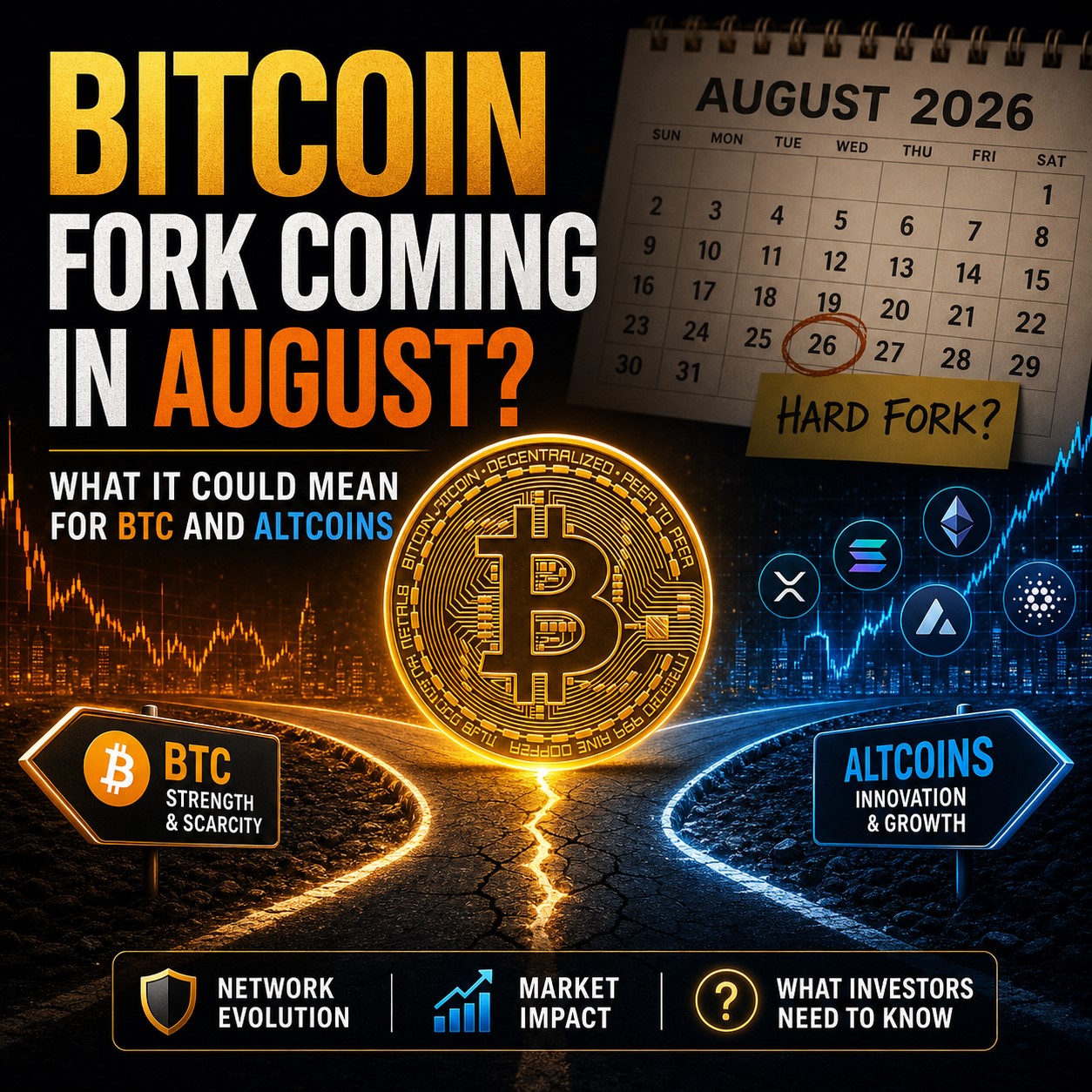
The August Bitcoin Fork: What It Could Mean for Bitcoin and Altcoins
A proposed Bitcoin hard fork known as eCash is being discussed for August 2026, tied to Bitcoin block 964,000 rather than a fixed calendar day. That means the exact date can shift slightly depending on mining speed, but current reporting places the event in August 2026.
The main reason for this hard fork is that a Bitcoin‑focused developer wants to create a new chain called eCash, which copies Bitcoin’s history and lets everyone who holds BTC at the snapshot receive an equal amount of the new forked coin. The goal is to experiment with faster blocks, new on‑chain features, and a more scalable network while keeping the same familiar Bitcoin‑style rules, rather than simply replaying past fork dramas. Because of this, some traders may buy BTC early to qualify for the forked coins, and the whole setup can change the timing of both buying and selling around the fork date.
What the fork actually is
A hard fork does not erase or replace the original Bitcoin chain. Instead, it creates a new chain that copies Bitcoin’s ledger up to a certain block and then continues under different rules, while the original Bitcoin chain keeps running as normal. In this case, the proposed fork would create a separate asset commonly described as eCash, and Bitcoin holders at the snapshot block would receive the new forked coin on the new chain if their platform supports it.
Possible impact on crypto prices before and after the fork
Many traders believe the upcoming August Bitcoin fork could create a clear pattern in crypto prices over the next few months:
- Between now and August:
Increasing demand for Bitcoin as more people buy BTC to qualify for the free forked coin could push Bitcoin and many altcoins higher, not just a little, but as a broad “risk‑on” move. - Mid‑to‑late August (around the snapshot):
Once everyone has locked in their forked coins, some traders are likely to sell Bitcoin and altcoins for profit, which can trigger a sharp pullback or dump in the middle of August. - After the fork goes live:
If the new forked coin is aggressively sold and rotated back into BTC, Bitcoin prices and altcoins could rise again; if most people ignore or dump the fork, the market may just keep drifting sideways or down.
This fork is not a guaranteed price game, but it could create a temporary price wave that affects BTC, XRP, XLM, SHIB, LUNC, and almost everything else that usually follows Bitcoin.
Why traders may buy Bitcoin before the snapshot
One likely scenario is that some traders buy more Bitcoin before the snapshot because holding BTC at the cutoff could entitle them to the forked coin on a 1:1 basis. This kind of setup can create a short-term demand boost for Bitcoin because the market starts treating BTC ownership as a way to receive an additional asset.
If Bitcoin rises on that expectation, older altcoins often rise with it because major crypto assets still tend to move with Bitcoin during broad market swings. That does not mean every altcoin rises equally, but it does support the idea that a Bitcoin run-up before the fork could lift much of the crypto market into August.
What could happen right after the snapshot
A second likely scenario is a classic “buy the rumor, sell the news” reaction. Once the snapshot has happened and traders believe they have secured the forked asset, some may sell Bitcoin, which could create short-term downward pressure on BTC and on altcoins that usually follow Bitcoin’s direction.
That said, a post-snapshot drop is not guaranteed. Past fork periods created volatility, but not a simple one-way crash, because Bitcoin’s price is also influenced by ETF flows, macro conditions, leverage, and overall market sentiment.
What could happen after the fork goes live
There is also a third scenario that matters just as much: many people may immediately dump the new forked coin and rotate the proceeds back into Bitcoin. If that happens at scale, those flows could support Bitcoin after the fork and potentially push BTC back up once the market starts valuing the forked coin as something to sell rather than hold.
In other words, the market could move in three stages: pre-fork buying of BTC, post-snapshot profit-taking in BTC, and then post-launch selling of the forked coin back into BTC. The exact outcome will depend on whether traders view the new coin as valuable enough to keep, or simply as something to dump for more real Bitcoin.
What history suggests
The most useful historical comparison is the 2017 Bitcoin Cash fork. Bitcoin holders received BCH after the split, and the period around the fork saw heavy speculation, exchange uncertainty, and major price swings in the new asset as the market tried to decide what BCH was worth. Bitcoin itself continued on its original chain, while the new fork traded separately and went through extreme volatility during its price-discovery phase.
That history supports a cautious conclusion: fork events can create strong narratives and sharp market moves, but they do not guarantee that the new chain succeeds or that Bitcoin follows only one direction. In many cases, the forked coin becomes a separate speculative asset while Bitcoin remains the dominant chain.
Practical examples to watch
- Pre-fork demand: Traders may buy BTC ahead of the snapshot to qualify for the forked coin, which could help push Bitcoin higher into August.
- Altcoin sympathy move: If Bitcoin rallies on fork speculation, many altcoins may also rise because they often move with BTC during broad crypto risk-on periods.
- Post-snapshot selling: Some traders may sell Bitcoin after the snapshot because they already locked in eligibility for the forked coin, which could pressure BTC and altcoins temporarily.
- Post-launch rotation back to BTC: If the forked coin is dumped aggressively, some of that value may rotate back into Bitcoin, which could support BTC after the fork goes live.
- Failure scenario: If the new chain fails to attract lasting demand, liquidity can dry up and the forked coin may fade while Bitcoin continues on as the main chain.
The key warning
The safest way to frame this event is not as a certainty, but as a volatility window. The proposed August 2026 fork could create a temporary rally into the snapshot, a sharp reaction after the snapshot, and then another move once traders decide whether to keep or dump the new coin. What happens next will depend on market psychology, exchange support, ETF and institutional flows, and whether the forked chain attracts any real adoption after launch.
A forked coin can exist on the new chain before most wallets or exchanges are ready to support it, so even people who are technically entitled to receive it may not be able to access or trade it right away. That delay can shift the timing of buying and selling, because some traders may wait until support is available before acting, while others may buy or sell BTC ahead of time and then react later once the forked coin becomes usable.
Also check out this recent video by Coin Bureau discussing the coming Bitcoin fork:
https://www.youtube.com/watch?v=itJpwsK3WVg
Satoshi’s Stash Gets Grabbed in eCash Bitcoin Fork
Coin Bureau
May 2, 2026