

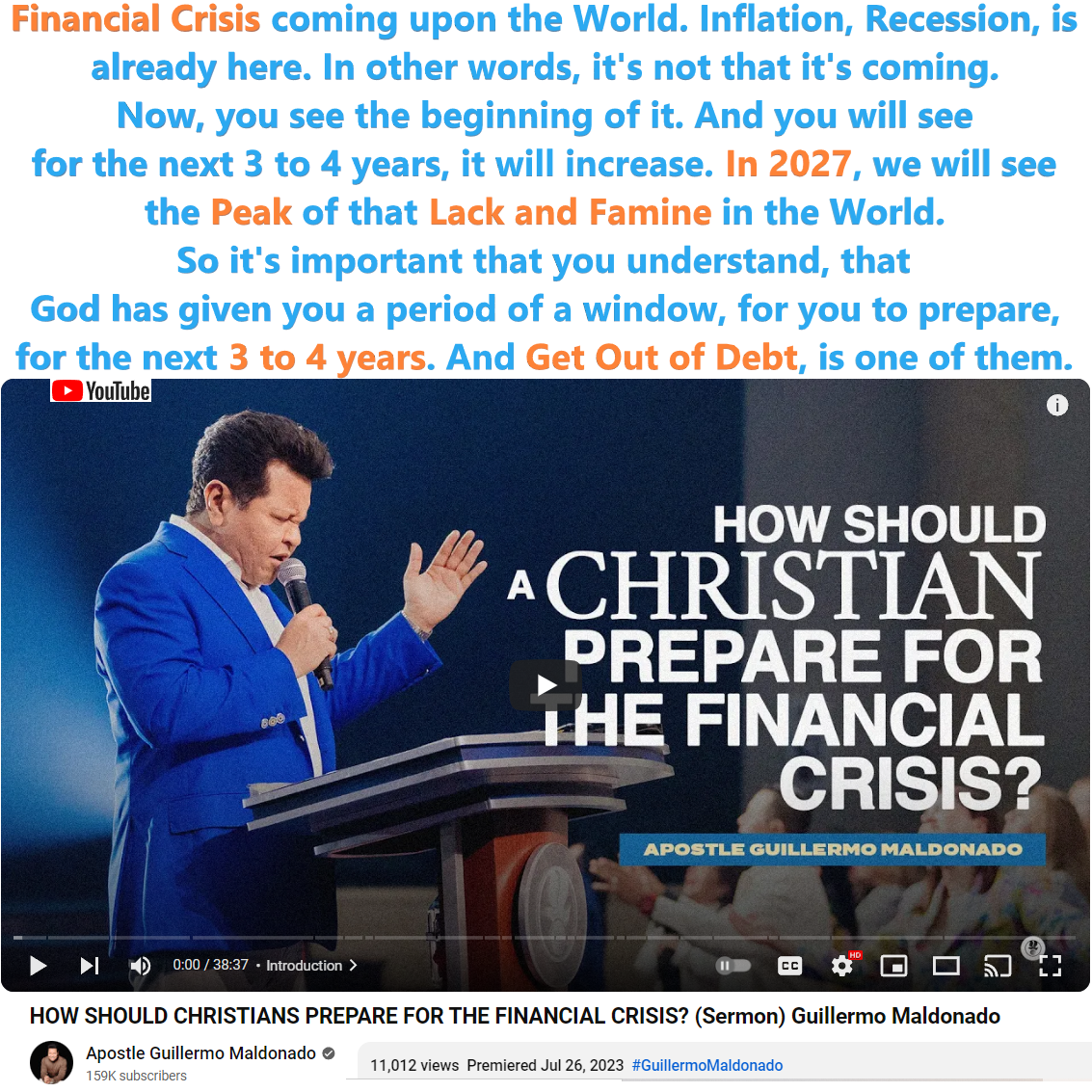
Financial Crisis is coming by Apostle Guillermo Maldonado. See partial transcript and video link below:
https://youtu.be/j_W7rHgQS80
HOW SHOULD CHRISTIANS PREPARE FOR THE FINANCIAL CRISIS? (Sermon) Guillermo Maldonado
Apostle Guillermo Maldonado @apostlegm
Premiered Jul 26, 2023
0:12 – I’ve been preaching for the last three years. And prophesying, and predicting, that there’s a Financial Crisis that are coming upon the World. I said upon the World. And I said if you got the numbers, Inflation, Recession, is already here. Luke 6:48-49. In other words, it’s not that it’s coming. Now, you see the beginning of it. And you will see it for the next 3 to 4 years. You will see, will increase. In 2027, we will see the peak of that Lack and Famine in the World. So it’s important that you understand, that God has given you a period of a window, for you to prepare, for the next 3 to 4 years. And Get Out of Debt, is one of them.
Luke 6:48-49 – They are like a man building a house, who dug down deep and laid the foundation on rock. When a flood came, the torrent struck that house but could not shake it, because it was well built. But the one who hears my words and does not put them into practice is like a man who built a house on the ground without a foundation. The moment the torrent struck that house, it collapsed and its destruction was complete.”
NotebookLM AI Summary:
The sermon addresses how Christians should prepare for the current and coming financial crisis, emphasizing that preparation is essential within a specific timeframe.
The Nature of the Crisis
The speaker asserts that the financial crisis (including inflation and recession) is not just coming but is already present. It is predicted to increase over the next three to four years and will see its peak of lack and famine globally around 2027. The crisis, described as a “flood” or “stream,” affects everyone, regardless of whether their “house is founded upon the rock”. However, crisis is also presented as a positive force, acting as a source of creativity because it demands a different way of thinking to solve problems and is the only way to develop faith. Financial crisis is often accompanied by other negative effects, such as depression, hopelessness, anxiety, fear, mental health issues, crime, drug addiction, and marriage issues.
Preparation and Correct Response
God has given a window—the next three to four years—for preparation. One preparatory action mentioned is getting out of debt.
The core response to the financial crisis should focus on two major principles, contrasting with common human responses:
- Multiplication, Not Saving: The poverty mentality focuses on saving, but the biblical principle is about multiplying by investing and creating ideas to produce. The goal is to trust in God as the source and provider, not in one’s job or business.
- Maintaining Values and Generosity: There are two great tragedies that occur when crisis hits:
- People compromise their values and principles (e.g., lying or corrupting their integrity). The sources emphasize that one must never compromise principles for money or necessities.
- People withdraw their generosity. Withdrawing generosity is considered the worst action, as it stops the provision that comes from heaven.
The Principle of Sowing and Reaping
The sources stress that financial preparation involves obeying the principle of sowing and reaping, which includes generosity. The world operates through holding and saving, but the people of God prosper through generosity.
Key Aspects of Sowing:
- Making a Decision: Preparation requires a decision to obey the principle of sowing and reaping; a decision is the ability to pre-program one’s mind for action.
- Active Giving: This principle means casting your “bread upon the waters,” making thoughtful decisions about where and what to sow, as the return will be found after many years.
- Maximum Generosity: Believers are instructed to “give a portion to seven, even divide it to eight” (the number of fullness), meaning to give the maximum possible, in preparation for future unknown misfortunes.
- Sowing Beyond Money: Generosity and sowing encompass more than finances; they include love, caring for people, helping people, praying for people, and serving people.
- Sowing in Faith: One must not wait for all conditions to be perfect to sow or give, as those conditions will never come; instead, action must be taken by faith. Isaac is cited as an example, as he planted and sowed during a famine and was blessed.
- Perseverance: People must not grow weary or discouraged in doing good, because they will reap at the proper time if they do not give in.
Ultimately, the objective of obeying these principles is to avoid withdrawing generosity and give God legal rights to bless them in the midst of the crisis. This enables believers to become “Josephs,” having the storehouses necessary to feed and preserve their families, neighbors, and the church when crisis hits.
Finally, the sources explain that generosity is not natural to human nature, which is inherently selfish; rather, a generous heart is produced by the grace of God. Jesus set the ultimate example: though rich, “he set aside his wealth and… became poor” so that through his poverty, others might become “abundantly blessed”. Believers are encouraged to never say “I don’t have” because God has always provided resources.