

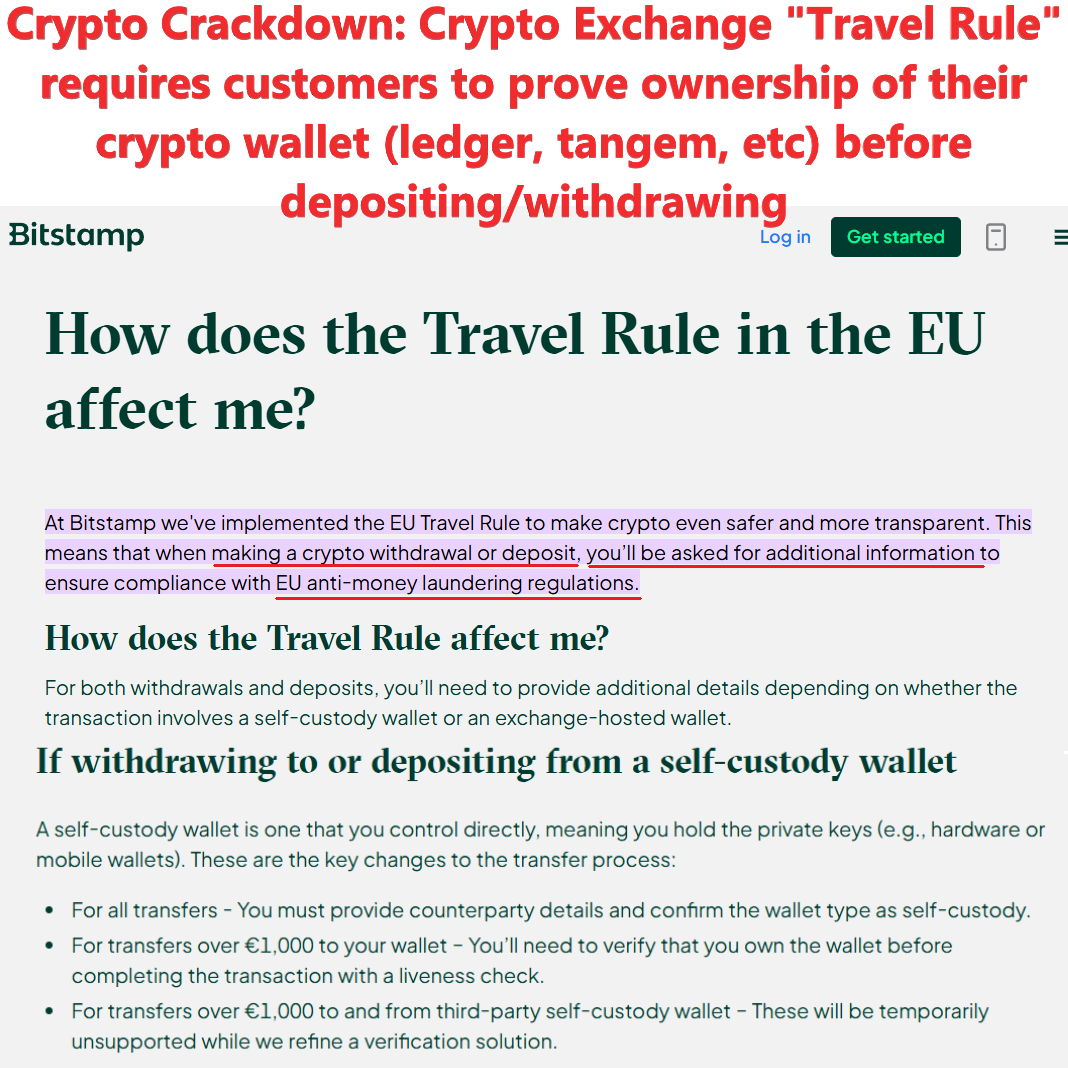
Prove Your Wallet Ownership – Crypto Crackdown: Crypto Exchange “Travel Rule” requires customers prove ownership of their crypto wallet before depositing/withdrawing.
Have you heard of the Crypto Travel Rule? It requires you to prove that you own the crypto wallet (ledger, tangem, etc.) address, before being able to deposit or withdraw from a crypto exchange. Bitstamp exchange sent out an email to their customers on 5/15/25 that this is now in effect. The Travel Rule has not yet been implemented by every exchange in every country – but it’s coming. Also, not every exchange is notifying their customers. So you won’t know until you try to transfer/withdraw…
This is why I recommend having a separate wallet address for every exchange/defi platform you use. So if you have issues with one exchange, and they blacklist your wallet address (and notify other exchanges), at least you’ll still have other crypto wallets you can use. Example, one ledger address for coinbase, another for kraken, another for gemini, another for pancake swap, and so on. And never transfer crypto between them.
5/15/25 Bitstamp exchange email to customers:
As shared in our previous communication, the Travel Rule is now in effect. This rule is designed to enhance the security of your crypto transactions by introducing a few changes to the transaction process.
What’s changing?
We covered the details in our previous email, but here’s a quick overview. Starting today, you’ll notice the following changes when depositing and withdrawing on the Bitstamp web platform, mobile app, or via API:
For all crypto transfers: You must provide counterparty information and determine whether the address is self-custody or hosted by an exchange.
In certain cases: We may request a one-time ownership verification to confirm you own the self-custody wallet, based on a risk assessment.
We know changes like this can be inconvenient, but they help make crypto safer and more transparent. We’ve done our best to make the process smooth and easy for you.
If you need further assistance, our support team is always ready to help at support@bitstamp.net.
Thank you for your trust and cooperation.
The Bitstamp team
I found an article showing step by step how one would prove ownership with a ledger wallet:
https://www.21analytics.ch/aopp/ledger/
Prove Wallet Ownership with Ledger and the AOPP Portal
https://www.bitstamp.net/faq/how-does-the-travel-rule-in-the-eu-affect-me/
How does the Travel Rule in the EU affect me?
At Bitstamp we’ve implemented the EU Travel Rule to make crypto even safer and more transparent. This means that when making a crypto withdrawal or deposit, you’ll be asked for additional information to ensure compliance with EU anti-money laundering regulations.
How does the Travel Rule affect me?
For both withdrawals and deposits, you’ll need to provide additional details depending on whether the transaction involves a self-custody wallet or an exchange-hosted wallet.
What do I need to do when withdrawing or depositing crypto?
When withdrawing crypto, you’ll need to first specify if you’re sending to a self-custody wallet or to an account at another crypto exchange.
If withdrawing to or depositing from a self-custody wallet
A self-custody wallet is one that you control directly, meaning you hold the private keys (e.g., hardware or mobile wallets). These are the key changes to the transfer process:
For all transfers – You must provide counterparty details and confirm the wallet type as self-custody.
For transfers over €1,000 to your wallet – You’ll need to verify that you own the wallet before completing the transaction with a liveness check.
For transfers over €1,000 to and from third-party self-custody wallet – These will be temporarily unsupported while we refine a verification solution.
If withdrawing to or depositing from an exchange wallet
For all transfers – You must provide counterparty details and select the exchange from a dropdown menu.
For deposits – We will attempt to gather the required information automatically before requesting additional details from you.
Where do I enter the info needed for the Travel Rule?
You’ll be prompted to provide the required Travel Rule details when making crypto transactions on any of Bitstamp’s platforms — web, mobile app, or API.
For guidance on using the API specifically, see our Travel Rule and Crypto withdrawal documentation.
Does Travel Rule affect how I trade on Bitstamp?
No. This only applies to crypto transfers (withdrawals and deposits). Trading is not affected.
What happens if I don’t give the required information?
Your withdrawal or deposits could be delayed or canceled if we don’t have everything we need.
What’s a self-custody wallet?
It’s a wallet you own and control yourself. Like a hardware wallet or an app wallet; not an exchange wallet.
Can I still send crypto to my cold wallet?
Yes! Just be ready to verify wallet ownership if the amount is over €1,000 and you haven’t verified that address before. It’s a once-per-address process. Once a wallet address is verified, you won’t need to do it again for future withdrawals.
How exactly do I verify that the wallet is mine?
To verify that the wallet is yours, you must complete a liveness check, which is a quick face verification video. You simply follow the instructions to record a short video showing your face.
How long does the verification process take?
It usually only takes a few minutes.
What happens if the wallet verification fails? Can I start again?
You’ll be able to try again if the verification was unsuccessful.
What if the exchange I’m sending to isn’t listed in the dropdown menu?
You can choose “Other” if your exchange isn’t listed and enter its name manually. Double-check the list first to avoid potential transfer delays.
Is my information safe?
Yes, absolutely. All information you provide will be handled with the utmost care. We only use your information to comply with regulations and make sure your transactions are secure.
Where can I get additional help with the Travel Rule process?
Pleaser reach out to us anytime at support@bitstamp.net. We’re here to help.
https://www.bitstamp.net/learn/security/what-is-the-travel-rule/
What is the Travel Rule?
October 23rd, 2024 /
Security
The Travel Rule mandates crypto exchanges to obtain, hold, and transmit required originator and beneficiary information immediately and securely during crypto asset transfers.
What is the Travel Rule?
This rule aims to enhance the ability of law enforcement agencies to track illicit funds and combat money laundering and terrorist financing.
Unpacking the Travel Rule
The Travel Rule is a term used to refer to a recommendation from the Financial Action Task Force (FATF) designed to combat money laundering and terrorism financing. In the context of crypto assets, the Travel Rule states that any crypto transaction of over a specified threshold respective to its jurisdiction must be accompanied by the personal information of the originator and beneficiary of the crypto asset transfer.
In other words, full transaction information, including the originators and beneficiary’s personal information, must “travel” along with the funds themselves through all the intermediaries involved in processing the transaction. The Travel Rule originated from traditional financial transactions.
Each member country in the FATF is responsible for passing regulations which enforce FATF recommendations like the Travel Rule.
Exchanges may request their users to provide additional information regarding the transaction before processing it. It is important to note that each exchange’s implementation of the Travel Rule may vary.