

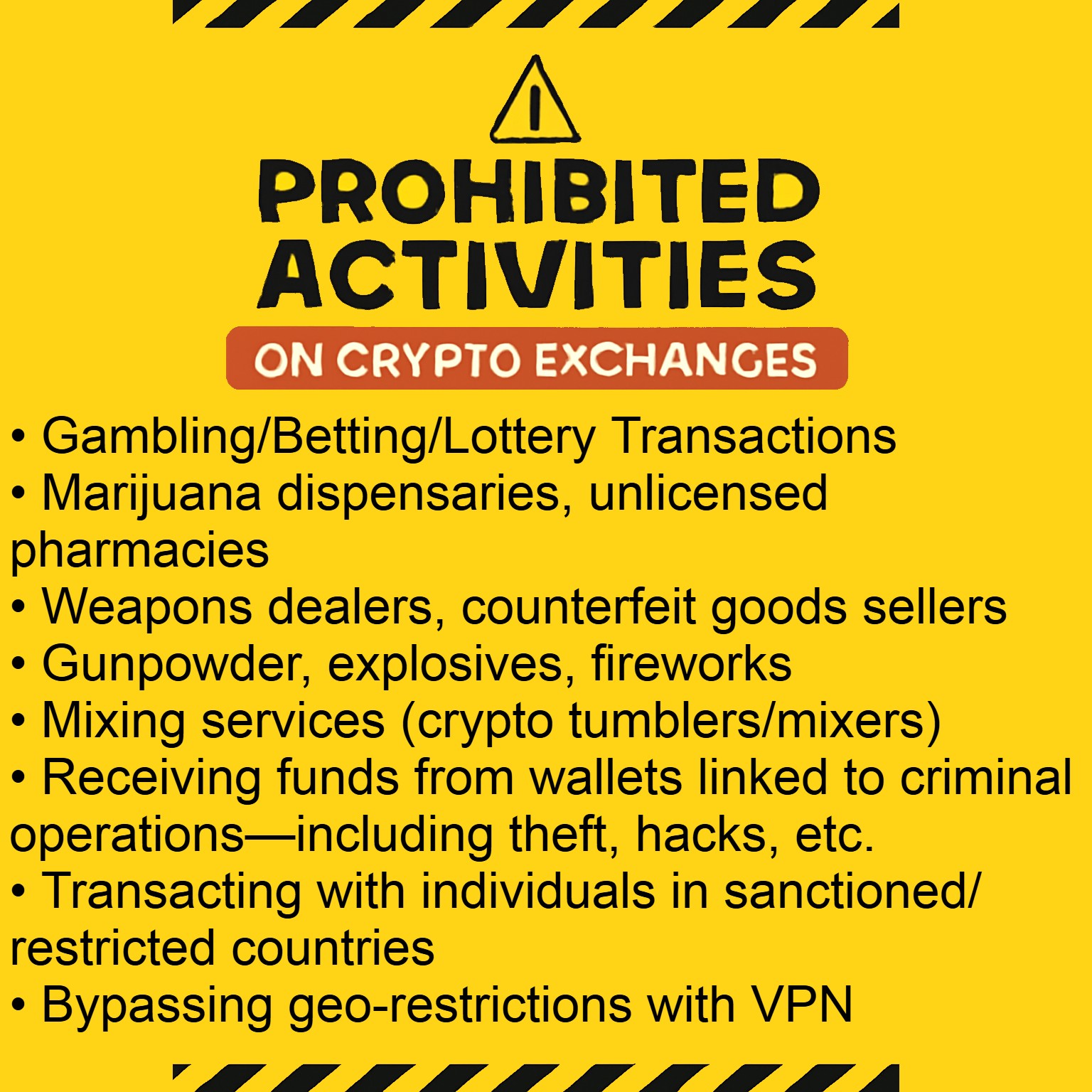
Crypto Exchanges will Freeze Your Crypto / Shut down your account, if you do any of these Prohibited Activities:
- Gambling/Betting/Lottery Transactions
- Marijuana dispensaries, unlicensed pharmacies, tobacco/vape shops
- Weapons dealers, counterfeit goods sellers
- Gunpowder, explosives, fireworks
- Mixing services (crypto tumblers/mixers)
- Receiving funds from wallets linked to criminal operations—including theft, hacks, or other illegal activity
- Transacting with individuals in sanctioned/restricted countries
- Bypassing geo-restrictions with VPN
See below for additional prohibited activities
I asked Perplexity AI to generate a list of prohibited activities that could get your crypto exchange account frozen or shut down permanently. It provided a list of prohibited items it found listed in the terms of different exchanges. But it also provided an additional list of things that may not be listed, but could still be considered prohibited by the exchange. For example, although adult content is not explicitly prohibited, child exploitation and human trafficking is prohibited, which can in theory fall into the adult content category. Another category is online pharmacies. Although only unlicensed/illegal online pharmacies are explicitly mentioned by exchanges like Coinbase, most people that could be ordering prescriptions online may be looking for a good deal, and may not even know that the pharmacy they’re using could be unlicensed/prohibited.
Using VPN is listed. However, VPN itself is allowed, you just can’t use it to bypass restrictions. For example, I was traveling and forgot to turn on my VPN. I received a crypto price increase notification from Gemini mobile app and clicked on it. Gemini flagged my account as being used outside of US and demanded bunch of documentation like airline tickets, sent me a huge questionnaire to answer, with questions such as whether I used a VPN. They froze my account in the meantime. VPNs often have two services, a regular VPN and a residential VPN that is assigned to you. Most financial sites can spot the difference. Residential VPN looks like a normal internet service (no one can see it’s a VPN). A Regular VPN is where you share your IP address with thousands of other people. When logging into Uphold I forgot to change my VPN connection to residential. My account was frozen for 3 weeks, and probably would have been longer if I didn’t keep bothering them on social media. And when they finally got to it, they unfroze it without many questions. Just said certain VPN providers trigger their security system, which automatically freezes accounts, and to be more careful. So in this example, VPN is not prohibited, but certain VPNs can cause the security system to freeze your account.
Most of these policies mention the word transaction. In the past people would just transfer crypto from wallet to wallet, but now most Exchanges like Coinbase offer crypto debit cards. Which means people can walk into a marijuana dispensary store, or a gun shop, or fireworks store, and try to pay with their Coinbase card – this is a prohibited transaction/activity. Tobacco, e-cigarettes, e-liquid is also prohibited. There are vape shops/kiosks popping up all around the world. Per Coinbase, any direct sale or purchase involving cigarettes, cigars, vaping products, and related goods is forbidden. So I think with the crypto debit cards it makes it much easier to get in trouble. Also, this list could change with time, and more prohibited items could be added without people even knowing.
Perplexity AI: Summary of Prohibited Activities and Items on Major Crypto Exchanges
1. Explicitly Prohibited Activities and Items (Clearly Stated in Exchange Terms)
- Gambling and Lottery: Sending funds to online casinos, sports betting, lottery operators, sweepstakes, or unauthorized games of chance.
- Marijuana and Cannabis-Related Businesses: Including dispensaries and related products.
- Firearms, Weapons, and Ammunition: Transactions involving guns, explosives, fireworks, gunpowder, or related goods.
- Use of Crypto Mixers (e.g., Tornado Cash): Services that anonymize crypto transactions are banned due to laundering risks.
- Transactions Linked to Sanctioned Countries: Engaging with or sending funds to entities or individuals in OFAC or UN sanctioned countries.
- Fraud, Misrepresentation, and Abuse: False information, phishing, hacking, chargeback fraud, unauthorized account access.
- Violation of AML/KYC Requirements: Failing to complete or circumventing anti-money laundering or identity verification processes.
- Interactions with Tainted Wallets: Transacting with wallets linked to hacks, theft, ransomware, or other illicit activities.
- Circumvention of Geo-Restrictions: Using VPNs, proxies, or falsifying location to bypass regional restrictions.
- Money Laundering and Illegal Financial Activity: Any dealings intended to obfuscate source of funds or launder money.
2. Often Overlooked or Commonly Prohibited, May Not Be Explicitly Detailed in Terms
- Fireworks, Explosives, and Related Materials: Often bundled with weapons in listings but sometimes overlooked.
- Tobacco and Nicotine Products: Sale or transactions involving cigarettes, e-cigarettes, vape juices.
- Prescription Pharmaceuticals and Unlicensed Medicine: Including online pharmacies or prescription drug sales.
- Drug Paraphernalia and Equipment: Items such as bongs, vaporizers, hookahs.
- Unapproved Health and Psychoactive Substances: Pseudo-pharmaceuticals like salvia, kratom, or other controlled substances.
- Adult Content and Services: Pornography, escort services, pay-per-view adult content.
- Stolen, Counterfeit, or Illegally Imported Goods: Designer knockoffs, stolen merchandise.
- Investment, Referral, or MLM Schemes: Pyramid schemes, multi-level marketing, or unverified investment opportunities.
- Credit Services or Debt Relief Services: Mortgage consulting, credit repair, check cashing.
- Unlicensed Money Transmission or Payment Processing: Acting as an intermediary or money transmitter without license.
- Charity or Donations Without Approval: Fundraising without proper authorization or nonprofit status.
- Platform Abuse and Infrastructure Attacks: Including attempts to overload systems or misuse accounts for spam or hacking.
Key Notes for Users:
- The explicit prohibitions are directly found in official user agreements and policies of exchanges like Coinbase, Binance, Kraken, Crypto.com, Gemini, and Uphold.
- The often overlooked category summarizes recurring issues observed through policy elaboration, user reports, and compliance practices, even if not spelled out verbatim in every exchange’s terms.
- Users engaging in any of these activities risk account freezing, fund withholding, or permanent closure, often without detailed explanation due to legal and regulatory constraints.
- Always consult the most current and specific terms provided by each exchange for exact details, as policies can evolve with regulatory changes.