Introduction: When Worship Becomes a Revenue Stream
Did you know that secular investors and corporations control and profit from a significant portion of the Christian worship music sung in churches today?
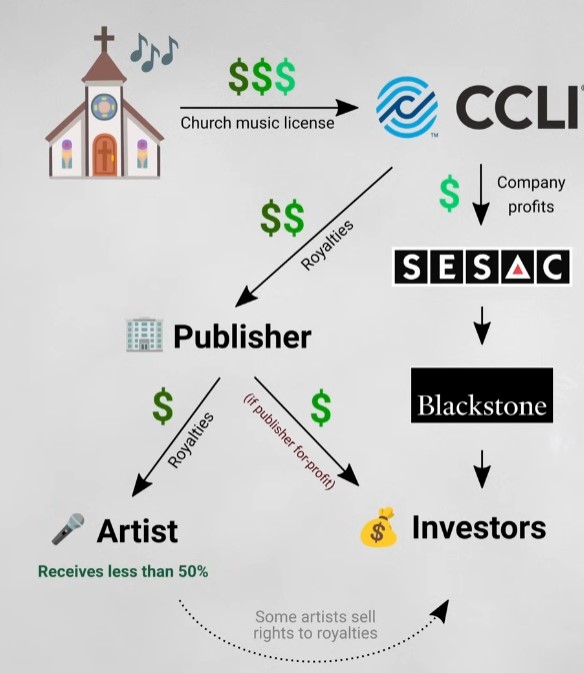
Christian Copyright Licensing International (CCLI) – the company that sells worship music licenses and collects fees from churches – has been owned by secular investment firms. At one point, its parent company also held major investments in Playboy, meaning churches were, in effect, paying dues to a conglomerate that was simultaneously sponsoring the pornography industry. This is not speculation or metaphor. This is the documented reality of how worship licensing works today.
The more secular capital flows into Christian music, the more incentive there is for investors to shape what songs churches sing and which artists are promoted – not based on theology or spiritual fruit, but on what generates the most licensing revenue. Many of the most widely used worship songs are published by for‑profit entities ultimately owned by hedge funds and investment firms.
If the enemy (satan) wanted to influence the theology, mood, and direction of corporate worship, would he not attempt to control its economic pipeline?
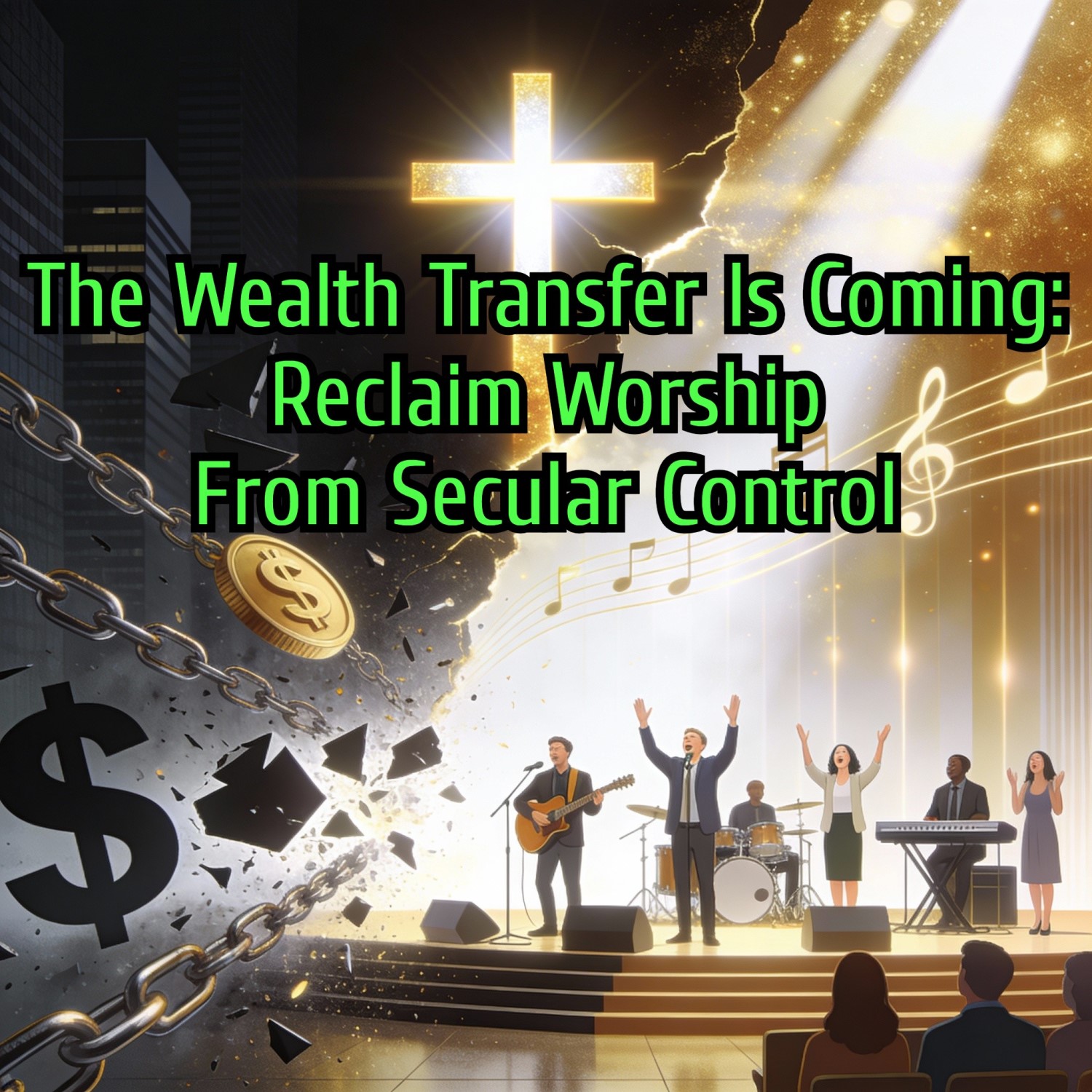
At the same time, many believers are expecting – and in some cases already experiencing – a supernatural wealth transfer from God: extraordinary financial provision entrusted to believers for kingdom purposes. What if part of that assignment is to liberate the worship of God, from secular ownership and commercial exploitation? In the post below, I list multiple ideas for using the Wealth Transfer to take back Christian Worship Music.
The Problem: Secular Control of Sacred Songs
How CCLI Turned a Legal Gap into a Business Model
In 1976, U.S. copyright law added a “religious service” exemption. Churches were given the explicit right to perform and display religious works in the course of services at a place of worship – without paying performance royalties. The reasoning was straightforward: worship is sacred and should not be hindered by copyright fees.
Decades later, technology changed how churches operated. Overhead projectors, transparencies, and eventually digital slides made it easy to project lyrics. But copying lyrics into a new format is considered reproduction, not just performance.
That legal gap – free to sing, but not free to copy lyrics – became the foundation of CCLI’s business model:
Churches pay annual license fees (tiered by congregation size)
CCLI grants permission to copy and project lyrics, print song sheets, and optionally stream or record services
CCLI keeps a percentage of the money and distributes the rest as royalties to publishers and artists
In practice, this means:
A church that mostly sings public‑domain hymns but occasionally uses a modern song still pays as though it used the catalog 100% of the time
Churches are paying primarily to copy lyrics on a screen for songs they already have the legal right to sing in a live, in‑person service
What began as a protective measure for songs has become a recurring revenue stream off congregational worship.
Who Actually Profits? The industry follows the same pattern as the secular music world:
A small number of celebrity worship artists and branded movements (Hillsong, Bethel, Elevation, etc.) dominate usage and thus royalty income
Many faithful Christian musicians receive little to nothing, despite creating music that edifies the church
Publishers and catalog owners – often controlled by large secular corporations – take significant shares of the revenue
CCLI itself operates as a for‑profit company, and its ownership has been tied to major secular investors, including those with holdings in the pornography industry
On top of that, song catalogs are now treated as financial assets. Portions of royalty streams for worship songs are being auctioned to investors, who buy them as income‑producing instruments. CCLI royalties are explicitly marketed as “a unique and lucrative source” of recurring revenue. Church worship, in other words, has become collateral in financial markets.
The Theological Issue: Selling What Was Given Freely Scripture is clear that those who preach the gospel and labor in ministry are worthy of support. But Scripture is also clear that spiritual ministry itself is not a commodity to be sold.
Jesus said, “Freely you received, freely give” (Matthew 10:8). The apostles received the gospel, spiritual gifts, and authority from Christ without charge, and they were commanded to minister that grace freely.
When Jesus drove the money changers and sellers out of the temple, He was furious that a place of worship had been turned into a marketplace. In that case, they were selling ordinary items (animals and sacrifices) in a holy place. Today, the church often sells spiritual things themselves – songs that are explicitly about and directed to God.
Worship songs are not merely entertainment. They are “psalms, hymns, and spiritual songs” meant to teach, admonish, and draw hearts directly to Christ. When the means of corporate worship is locked behind perpetual licensing fees, administered for profit, something is deeply out of order.
The problem is not that artists are supported – that is right and biblical. The problem is that:
Access to worship material itself is monetized
A significant portion of revenue flows to secular investors and corporations
The system is structured to maximize ongoing profit from congregational worship
This is more than a business question. It is a worship question. It is a holiness question.
The Wealth Transfer: A Kingdom Opportunity Many believers sense that God is orchestrating a supernatural wealth transfer – a season where He entrusts significant financial resources to His people for kingdom purposes:
Translating and printing Bibles
Sending missionaries to unreached people groups
Planting churches and funding evangelistic campaigns
Hosting large‑scale revival gatherings in stadiums
To that list, another strategic objective should be added: Liberate the worship of God from secular ownership and commercial exploitation.
If God entrusts believers with great wealth, it is not merely to operate within the existing Babylonian systems more comfortably. It is to confront, redeem, and replace those systems with kingdom structures that honor Christ. The current Christian music licensing ecosystem is ripe for such intervention.
How Wealth Transfer Recipients Can Fix the System Below are several practical, high‑leverage strategies that wealthy believers could implement to transform the worship music ecosystem.
1. Acquire and Convert CCLI
Vision: Buy the gatekeeper and turn it into a servant.
A group of Christian investors could purchase CCLI from its current owners
Restructure it as a nonprofit ministry instead of a for‑profit corporation
Replace the profit mandate with a kingdom mandate:
Equitable support for artists
Free or deeply subsidized access for churches in poor and persecuted regions
Transparency in where every dollar goes
Prioritization of theologically sound, Christ‑exalting songs over commercial trends
Instead of churches unknowingly funding secular shareholders (and indirectly, even pornography investors), license fees could be redirected toward missions, Bible translation, and support for faithful songwriters. This is a large, complex move – but not beyond the reach of serious wealth transfer recipients.
2. Launch a Nonprofit Alternative: A “Kingdom Music Commons”
Vision: Create a better option that makes the old system obsolete.
Establish a nonprofit licensing cooperative whose charter is to serve churches, not investors
Provide a simple, low‑cost or even pay‑what‑you‑can annual license that covers:
Lyrics projection
Printing
Recording
Streaming
Translation for missions
Use all surplus funds for:
Directly supporting songwriters
Funding the creation of free, public‑domain worship music
Subsidizing access for churches in poor nations
By underpricing CCLI and operating with radical transparency, such a platform would quickly attract churches whose consciences are troubled by the current system – but who still need some form of licensing during transition.
3. Directly Fund Public-Domain Worship Music at Scale
Vision: Flood the church with high‑quality free music.
Create a fund that pays Christian songwriters to release their songs into the public domain (no copyright, no licensing restrictions)
Offer generous one‑time grants (for example, $5,000–$25,000) per song that is:
Theologically sound
Congregationally singable
Released fully free for any church to use, translate, record, and share
Provide multi‑year support for an entire generation of worship writers who covenant to release all their work freely
Within a few years, the global church could have a vast catalog of modern worship songs that require no license at all. CCLI and similar models would simply become unnecessary for most congregations.
4. Raise Up a New Generation of Free-Worship Musicians
Vision: Do what the Selling Jesus video calls for – at scale. (See bottom of post for link to video)
At the end of the video, the author lays out a simple blueprint:
Build a free public-domain collection Release new songs into the public domain so churches can build a growing library of modern, congregational worship music available free to all.
Raise up a new generation of worship musicians Actively recruit and mentor young musicians, teaching them about the sanctity of worship and admonishing them against any commercialization of ministry.
Model alternative support Show musicians that financial provision can come through direct giving from God’s people—just as it does for pastors and missionaries—not through recurring royalties and licensing schemes.
Wealth transfer recipients can turbo‑charge this process by:
Funding training programs and schools for worship leaders who commit to free ministry
Sponsoring songwriting retreats where the explicit goal is to produce public‑domain songs for the global church
Partnering with platforms (like copy.church and others) that are already building catalogs of free modern worship music
5. Transform the Culture, Not Just the Infrastructure
Vision: Change what the church believes about selling ministry.
Even with new structures in place, lasting change requires a shift in mindset:
Pastors need to teach that worship is sacred and should not be commercialized
Churches must be willing to adjust their song choices for the sake of integrity—not just convenience
Artists must see themselves first as ministers, not as content creators seeking market share
Wealth transfer can fund:
Theological resources, documentaries, and teaching series that expose the current system and present a biblical alternative
Scholarships for musicians who commit to a free‑ministry model
Conferences and gatherings that call the worship movement back to “the heart of worship” in practice, not just in lyrics
A Possible Future: Worship That Is Truly Free Imagine a future where:
No church ever has to ask, “Can we afford to sing this song?”
Persecuted believers can translate and sing powerful worship songs in their own language without fearing lawsuits or fees
Churches in the poorest nations never have to divert scarce resources to licensing companies
The most anointed, Christ‑centered worship songs in the world are not the ones most profitable to investors, but the ones freely poured out before the Lord
Christian artists are abundantly supported by God’s people—but their work is never locked behind paywalls and perpetual royalties
This is not utopian. It is a realistic outcome if a relatively small number of obedient, wealthy believers decide that reclaiming worship is part of their assignment in this wealth transfer.
Conclusion: Freely You Have Received, Freely Give God is indeed transferring wealth into the hands of His people. With that wealth comes responsibility. Translating and printing Bibles, sending missionaries, and funding revival gatherings are critical. But if the songs that shape the hearts of those believers remain controlled by secular investors and governed by a profit model, the church will still be discipled at the altar of Mammon, even while it preaches revival. Jesus commanded, “Freely you received, freely give.” Worship songs are not exempt from this command. They are at the center of it.
Wealth transfer recipients have a rare opportunity:
To buy back what has been sold
To build new structures that serve, not exploit
To model a kingdom economy where ministry is not a product, but a gift
The question is not merely, “What can we do with this wealth?” The deeper question is, “How can we ensure that the worship of God is no longer a revenue stream for the world, but a free offering from the bride to her Bridegroom?” That is a vision worth funding.
The Christian music industry commercializes the worship of God. A copyright cartel maintains control of sacred songs and even sells them to secular investors. While churches have a legal exemption to perform copyrighted music during services, copying lyrics for digital presentations isn’t covered. This legal gap has led to the rise of Christian Copyright Licensing International (CCLI), which charges churches annual fees for various permissions to use songs. This system financially burdens congregations and primarily benefits a select group of artists and organizations, some with questionable practices or theology. It also serves to make sincere worshipers in other countries into lawbreakers.
NotebookLM AI Summary:
Modern worship music is currently governed by a commercial licensing system that requires churches to pay annual fees to use copyrighted songs. This practice is facilitated largely by Christian Copyright Licensing International (CCLI), a for-profit organization that holds a virtual monopoly and serves over 250,000 churches globally. The source compares this current reality to a hypothetical “prayer tax,” where churches would be forced to pay and report every prayer recited during a service to avoid legal infringement.
Several key concerns regarding this system are highlighted in the sources:
Secular Profit from Worship: While CCLI identifies as a Christian organization, it is owned by secular investment firms like Blackstone, which seeks to maximize profits for shareholders. This means secular investors—some with ties to disreputable industries—profit directly from the act of worship.
Artist Inequality: Licensing fees do not necessarily support the artists who need it most; instead, royalties often flow to a select few celebrity artists or large entities like Hillsong, Bethel, and Elevation. Furthermore, some artists “tweak” public domain hymns to collect royalties on new versions of songs that were previously free.
Legal Nuances and Streaming: In the United States, a religious exemption exists that allows churches to perform sacred music for free during services. However, this exemption does not cover copying lyrics onto digital slides or streaming services online, which is why churches feel compelled to purchase CCLI licenses.
Theological Objections: The source argues that commercializing ministry is unbiblical, citing Jesus’ anger at those who sought to profit from the temple in John 2:13-17. It suggests that “spiritual songs” should not be treated as ordinary commercial products.
To address these issues, the sources advocate for a return to a “freely give” model of ministry. This involves musicians releasing new songs into the public domain and churches moving away from commercialized music systems. The late artist Keith Green is cited as a role model for this approach, as he famously refused to charge for his music or concert tickets, believing that ministry should never be sold.
To understand the legal loophole churches face, consider the U.S. religious exemption as a “free pass” to walk through a park (perform music), but as soon as you take a photograph of the scenery to show others (streaming) or print a map for the group (copying lyrics), you are suddenly required to pay a toll.
With corporate consolidation in worship music, more entities are invested in the songs sung on Sunday mornings. How will their financial incentives shape the church?
NotebookLM AI Summary
The contemporary worship music industry is undergoing a significant shift as corporate consolidation and private investment turn spiritual songs into lucrative financial assets,. Major entities like Capitol Christian Music Group (CCMG), which is owned by Universal Music Group, have acquired numerous Christian labels and now control a substantial share of the top worship songs used in churches,. This commercial interest is driven by the stability of royalty streams, particularly through Christian Copyright Licensing International (CCLI), which tracks song usage in over a quarter-million churches worldwide,.
Key developments in this commercialization include:
Acquisition of Song Catalogs: Private investors and funds, such as the Blackstone-backed Hipgnosis Songs Fund, are purchasing the back catalogs of prominent worship artists like Matt Redman and Jason Ingram,. These “evergreen” worship hits are seen as stable assets that provide reliable returns, sometimes projected at nearly 15 percent,.
Increased Revenue from Livestreaming: The COVID-19 pandemic led to a substantial rise in royalty revenues because churches had to purchase additional licenses to legally stream their services on platforms like YouTube,.
The Rise of Arena Tours: Worship artists now fill large stadiums, often mirroring secular pop stars by offering VIP “experience packages” that include early entry, merchandise, and photo opportunities,,. These tours generate significant revenue while blurring the lines between a worship service and a commercial performance,.
This “feeding frenzy” of investment has raised concerns among theologians and industry experts regarding the spiritual and theological impact on the church,. Critics argue that when market forces drive song selection, the diversity of God’s kingdom is narrowed into a “market-shaped” sound. For example, the industry tends to promote songs of joy and adoration because they are more profitable, while largely neglecting themes of lament and sorrow, which are less commercially viable.
Furthermore, the pressure to produce “hits” creates a celebrity culture where local worship leaders feel they must emulate the fashion, gear, and vocal styles of famous artists to be considered successful. While many songwriters maintain that their work is a spiritual calling intended to serve the church, the increasing involvement of secular stakeholders means that the incentives of fame and financial success may increasingly influence how worship music is produced and promoted,,.
To understand this shift, imagine a local community garden that has been purchased by a multinational corporation: while the neighbors still come to plant seeds and find peace, the types of flowers grown and the layout of the paths are now determined by what will look best in a catalog and generate the most tourism revenue.