

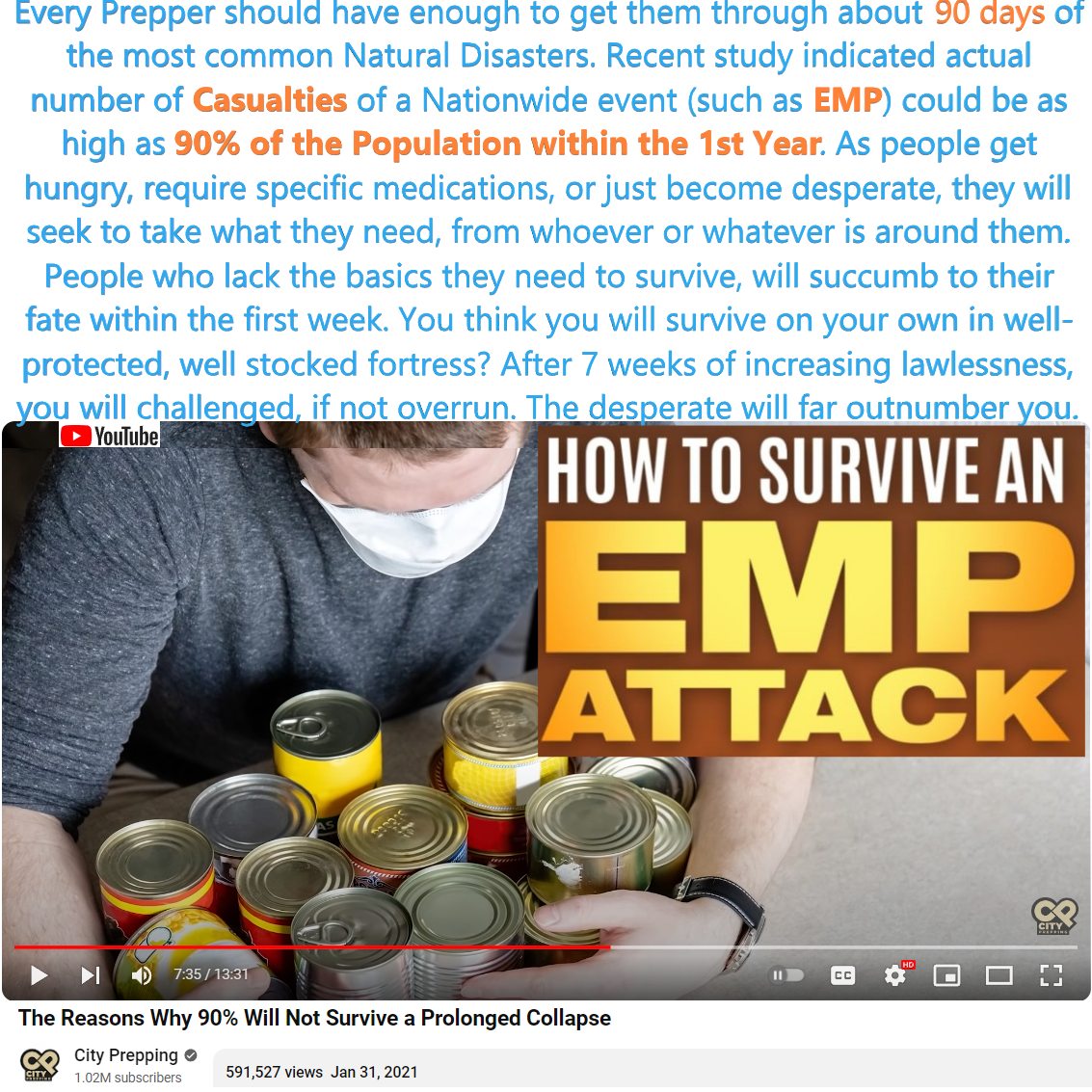
Did you know that 90% of the Population will Die within the 1st Year of a National Disaster, like an EMP attack? You hear many people say you need to stock up and buy all this water, food, silver/gold, guns, ammo, solar panels, generators, etc. And these will protect you. You also hear people say, when the dollar crashes, you will be able to buy groceries and gasoline, with your Silver eagle coins. But what they don’t tell you is, most of the population will not be prepared, and won’t have silver coins, food, and water, when disaster strikes. And when people become desperate, they may kill and rob those who did prepare. Just imagine, you and everyone on your street has no electricity, and not prepared, and now yours and their families are starving. And you all see one house at the end of the street with lights on, and smoke coming out of the chimney and something smells good. What will you and the others do? See below for an expert’s explanation of what will happen when disaster strikes. We already know that God’s remnant will be protected, just like Israelites during the Great Exodus and the 10 Plagues/Disasters. But this video provides practical advice, so that if a disaster comes, you are ready.
https://youtu.be/1DV2YzIPYAU
The Reasons Why 90% Will Not Survive a Prolonged Collapse
City Prepping
Jan 31, 2021
While many consider themselves ready for a major disaster, the reality is that many simply will not survive. In this video, we’ll look at what you can expect after a major disaster to help you prepare
0:51 — even a beginner prepper, should have enough to get them through about 90 days of the most common natural disasters. But in an actual prolonged grid down situation, even the most well prepared, they’re not going to survive. Maybe they will not perish at the same rate as everyone else. Still, even a catastrophic extreme event such as an EMP that may have very low initial mortality numbers, will have exponentially high death tolls, when things truly fall apart. A recent study indicated that the actual numbers of casualties in the aftermath of such a nationwide event, could range between two-thirds of the population, to as high as 90 percent of the people, within the first year.
1:55 — Location, location, location. Your place and proximity to the occurrence, is a determinant of your initial rate of survival. With nearly 80 of the individuals living in either an urban or suburban environment, many are dependent on the Grid for survival. Those who live in the country like to say that those in the city are certainly going to perish. Bugging out of the city may indeed be your best response. However, living in a City is not a death sentence. Urban dwelling simply carries with it more competition for resources, and a greater possibility of crowd chaos.
2:23 — if you live in the country, you may consider yourself isolated with a good line of sight over an acre, in every direction. Because of your isolation, you’re likely already in some ways a prepper, because you aren’t going to simply pop over to the market when you need a cup of sugar. The country prepper has some clear advantages.
2:40 — however, large swaths of people could move to the country preppers’ area or land, to find resources. Or go to where resources are rumored to be, in a real SHTF situation. They may even try to take your resources, and could overwhelm you with their numbers.
2:52 — so when it comes to location, there are no guarantees of safety. Your first true consideration concerning location is how close you are to the epicenter, and impacted area. A second is whether your location is tenable (able to be defended). That is when the disaster hits, is the place you’re at where you’re going to stay, and is it defensible in stock.
3:11 — it is nowhere near the 20 miles or more you would be. or when you’re away from home. maybe you could traverse a distance, but millions would not be able to make it back to their homes.
3:19 — as those people get hungry, require specific medications, or just become desperate, they will seek to take what they need, from whoever or whatever is around them.
3:28 — many will die in an SHTF situation simply because they’re too far from home, when the disaster strikes.
3:33 — you can put the odds in your favor, by prepping your body for the rigors you could face. you could set the odds in your favor by having an everyday carry bag with a few essentials, to ensure you can get home. you can put the odds in your favor by having a survival cache in place along your route. you can set the odds of survival in your favor, by knowing more than one route of escape, and more than one route home.
3:56 — people who lack the basics they need to survive, will succumb to their fate within the first week.
5:06 — so what happens when the majority of people run out of food and water? remember what alfred henry lewis wrote. there are only nine meals between mankind and anarchy.
5:33 — if the municipal water systems fail, how much bottled water would it take to provide the same level of fresh drinkable water to a thirsty population?
5:41 — if boil orders were in effect, how many people would really know, without the announcement?
5:45 — absent natural gas and electricity, how many people could boil their water?
5:49 — fires attract attention. so how much water could you boil, without someone looking to take a share of it for their own?
5:55 — the majority of people cannot obtain their food from their environment, nor have enough food stored, to sustain them.
6:01 — how close to their N’th skipped meal will they be, before they cross their moral lines and loot the store shelves? how long before they pick all the fruit from your trees? how long before they show up at your doorstep looking for a handout or a hand up?
6:24 — nine meals are about 72 hours. that’s when desperation begins to set in for some.
6:37 — just as the toilet paper panic of 2020, the global rice crisis of 2008, should have taught us. it only takes a little fear, before the herd tramples over everything, and everyone, in their path. to clear out and hoard everything it can grab.
6:50 — if that is the first 72 hours after a natural disaster, imagine what it would look like after the first 7 weeks? those who lack food and water at the 72 hour mark, will be frail and suffering from the effects of starvation. everyone’s a little different but most people can only go without food for between one to two months. most people can only survive without water for about 3 days. if that water isn’t clean, there’s a host of things that can make them sick enough to die. without proper medical attention, after seven weeks with no return to civility, and no restoration of supply lines. in the future, desperation will turn to lawlessness for many, and will result in death for even more.
7:24 — even communities with adequate supplies, decent foraging resources, and good water resources, will have to defend themselves from being overrun by hordes of people trying to survive.
7:33 — you think you’ll be a lone wolf, and survive on your own, in your well-protected, and well-stocked fortress? It is likely that after 7 weeks of increasing lawlessness, and with no sight of the future being any brighter, you will be challenged, if not overrun. The desperate will far outnumber you.
7:50 — to put the odds in your favor, or being part of that 10 who will survive, do these things:
- make sure your food water fire shelter supplies are enough to sustain you at least 90 days and preferably much longer.
- make sure that at least some large percentage of those supplies are mobile.
- learning how to purify water in the wild, and it will all be wild after 90 days, is essential to your survival.
- knowing how to scavenge and forage is critical, even if you have a fixed and secure home base of operation.
- Do you have a mobile shelter? if you’re forced out of your home base of operation, even a tent or tarp, could get you through a rainy night.
- Set aside about 10% of your supplies for those you love and trust, will come to you in desperation. community is an often overlooked aspect of surviving…
9:30 — Medical dependent — like a herd has its weakest at the back most likely to succumb to predators. people are similar. the medically dependent, those in need of elder care, and neonatal individuals, are at an extremely high risk of succumbing within the first few days, weeks, and months. if you require insulin, for example, when the supply dries up, and you’re limited to just what you have on hand, or can store up. the shelf life of that supply ranges from 14 to about 56 days. what then? those in critical condition in hospitals, or assisted living facilities, will not get their needs met, as supplies dwindle, and staff are forced to look after their own first. anyone on medications that require little weaning off, or that have severe withdrawals, or are required for life, will all be the first to go. pharmacies will be looted, and manufacturers will stop producing new supplies. some may make it through with an understanding of herbal medicines. but some may require prescription level doses of medications, that truckloads of herbs simply will not provide.
10:26 — if you can’t set your bone, or stitch a wound, or tree cuts that may become infected, you’re at a high risk of succumbing at some point, to the aftermath of the disaster.
 Prophetic Money