

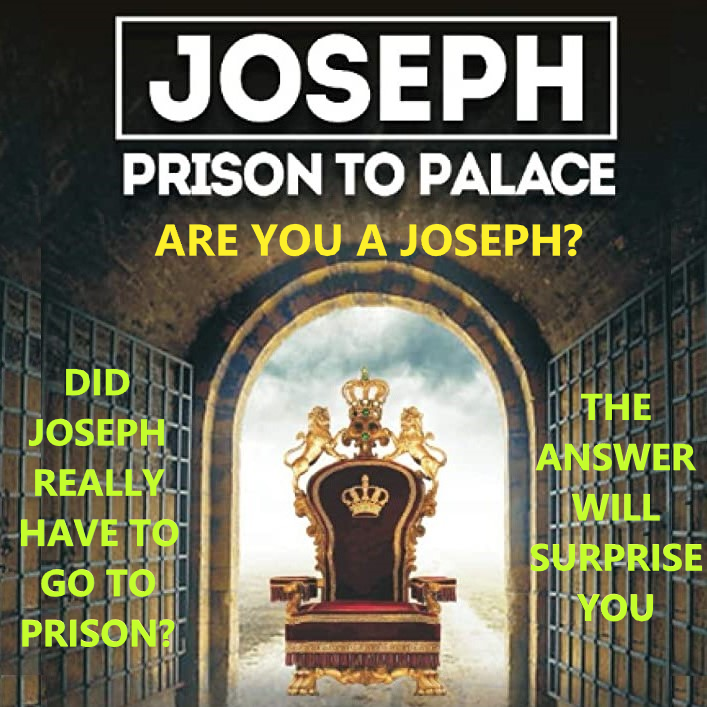
Are You a Joseph?
On 4/2/23, during Sunday Morning Service, Robin D Bullock, shared a powerful message about Joseph who went from the Pit, to the Prison, to the Palace. This teaching is much different than many of you have probably heard before. Robin explained how Joseph did not have to go into the Pit or the Prison, to get to the Palace. He also explained that God does not send us to the Valley/Pit, but we ourselves choose to go to the Valley/Pit, and then we blame God for it. See below for the link to the video and partial transcript.
https://www.facebook.com/churchinternat/videos/1819017378485462
https://www.youtube.com/live/6ZZLL34FSaw
Sunday Morning Service 4/2/2023
Church International
2:42:45 — The details are determined by your decisions. You can get there. But you can also get sidetracked. And get put into a place that can stifle and possibly stop your progression. Joseph told his brothers. Maybe he should have told his father alone. For instance, Joseph told his brothers, they sold him into slavery. Then Potiphar’s house. Joseph ruled over Potiphar’s house. Then he went and got himself into a position with Potiphar’s wife, alone. Maybe that was not a right decision. He saw the destiny. But his decisions determined the path that took him there.
They put him in prison — he ruled the prison. There, he asked for help. You heard it when he told the cupbearer, remember me. Two years passed. Pharaoh had a dream. Joseph interprets it, and he rules Egypt. His brothers came to him. Joseph said to his brothers. I have divined the order of your birth through my magic cup. So he sets Benjamin up. But then he has compassion. So he was not derailed again. He could have gotten to the palace, without going to the pit. He could have gotten to the palace without Potiphar. He could have gotten to the palace without the prison. How? I don’t know. The decision wasn’t made.
But it was parallel to Jesus Christ. Jesus died for the disobedient. So even through his disobedience he got there. But his obedience got him out of the decision. When Judah offered to give himself for Joseph. Remember, Judah said, take me instead. So you can see the big destiny. But the decisions you take, determine that path that takes you there. Joseph wasn’t sent to the pit to get him to Egypt. God could have gotten him to Egypt. Joseph was a prince. Jacob was wealthy. Jacob was known. Abraham was known by Pharaoh, before. Abraham was famous in Egypt. His family was very famous. Isaac was famous with Kings. Jacob was known. He could have gotten him there. How? I don’t know. The decision wasn’t made. It preaches good — from the pit, to the prison, to the palace. But that’s not necessarily what could have happened. And so, you can see the destiny that you have ahead of you, but the details may not be clear to you yet.
And that brings up — the Lord meant it for Good. What did he mean? He meant to get him on that throne. He meant to get him to position of authority. And that very last decision. He said, I could divine, he set Benjamin up like a thief. And then, Judah said, take me instead of the boy. His compassion turned the whole thing. If he had went through with that, what would have happened next? I don’t know. The decision wasn’t made. So what has the Lord shown you, about your end destiny? He said I know the thoughts I have for you, thoughts to prosper you, thoughts to give you and expected end, thoughts to give you a future. And He sees the big picture.
2:49:30 — Well, God’s got me in this valley, He’s really punishing me. Really, is that what you believe? (Psalm 23:1 — The Lord is my shepherd; I shall not want.) Right there shows you, that He (God) did not put you in the valley. So what does put you in the valley? Let’s see of what God’s guilty of. (Psalm 23:2 — He maketh me to lie down in green pastures: he leadeth me beside the still waters). He makes me to lie down in green pastures, by the prospering green fields. So he’s guilty of that. He leads me beside still waters. That’s what He does. (Psalm 23:3 — He restoreth my soul: he leadeth me in the paths of righteousness for his name’s sake.) He restores my soul. He does all these things. He leads me in the paths of righteousness for his name’s sake. So His name’s sake is on the line here. So He’s not going to make decisions to hurt you, because His name is on the line.
So what gets us in the valley? (Psalm 23:4 — Yea, though I walk through the valley of the shadow of death, I will fear no evil: for thou art with me; thy rod and thy staff they comfort me). Yeah, though I walk — now we’re finding out what you do. Yeah, though I walk through the valley of the shadow of death. Wait a minute, the Lord did not put you in the valley then? It says, you did. “We” put ourselves in the valley. Yea, though I walk through the valley of the shadow of death. Though, I forget all His good things, He’s doing, and I decide, I’m gonna go down through that valley of the shadow of death. He said, I will fear no evil, even though I have blew it. For Thou art with me; Thy rod, and Thy staff, they comfort me. So you know, He’s with you.
2:53:30 — So don’t get in the valley and say — where are you? Don’t go down there and say, I wonder where He is. He’s got a reason for this. He never said, He led you there. He said, you went there. Why did you go there? Well, there are a lot of reasons why people go there. See, Paul talks about you running a race. And if there is a race, then there is a track we run on. If you stay on that track, everything you need for tomorrow is on that track. Everything you need to prosper you, to give you that future. Your water, your food, your sustenance, your housing, your cars, the deliverance of your children; everything is up there on that track. You just gotta stay on that track. But here is what people do. They start up the track, but over there on another track, you see something shiny. You say, wait a minute God, and you get off, and walk down the alley, and you go drag something or somebody from another track. You get them up here on your track. You get that thing on your track — well I gotta have this, this is what I’m born todo — it could be career, it could be people, it could be anything. But it wasn’t on your track — you were never even supposed to meet them.
2:56:30 — And so you drag them back to your track. They don’t want (to be) on your track. They don’t think like you, act like you, talk like you, sing like you. They don’t want to be on that track. They had their own track. But you want them on your track. So you get a good grip, and you hold them beside your track. And you’re dragging the along, beating their head on every crosstie. And the burden gets heavy. And they’re screaming. And you finally stop and say — the burden is heavy.
2:57:30 — And then you repent. And suddenly, maybe this person decides they now want to be on your track. So the Lord creates a whole new track. But you never gonna find out either way, as long as you blame God, for you going through that valley. He didn’t put you in that valley.
2:58:00 — (Psalm 23:5 — Thou preparest a table). Now we’re back to what He does. You prepared a table before me in the presence of mine enemies. You anoint my head with oil. My cup runs over. Surely goodness and mercy shall follow me all the days of my life, and I will dwell in the house of the Lord for ever. He told everything He did, and everything you do. So why you gonna contribute what you do, to Him? He didn’t do that. The thief came to steal, kill, and destroy. Jesus said, I have come that you may have life, and life more abundantly. That’s God and the devil, right there. And they never cross.
3:01:45 — So He (James) said, let no man say when he is tempted. The word tempt there, is the Greek word: temp, test, or tried. Let no man say, when I’m tempted, tested, or tried, that I am tempted, tested, or tried, of God. For God cannot be tempted, tested, or tried with evil, neither tempts, tests, or tries he any man. You cannot read that scripture and say, God is trying you, and be in obedience with the word. But every man is tempted, tested, or tried, when he is drawn away of his own lust. Yeah, though I walk. Then when lust has conceived, it brings forth sin: and when sin is finished, it brings forth death.
Then he says, do not get in this error. Do not err, my beloved brethren. He’s not talking to sinners, He’s talking to us. What error, James? Every good gift and perfect gift is from above, and comes down from the Father of lights, with whom is no variableness, neither shadow of turning. If you can hear this today, you can walk towards the destiny you have ahead of you, without making the decisions that put you in the pit, the prison. Because, God didn’t get you there. Just so you know, the word “evil” there, means “anything that’s not as it should be”. So God can’t be tempted, tested, or tried, with anything that’s not as it should be. So it said, neither tempts, tests, or tries He any man. He can’t do something to you, that can’t be done to Him. But we have decisions. And decisions determine the path. So we make decisions, according to His word, that puts you in your future.
Genesis 44:5 — Isn’t this the cup my master drinks from and also uses for divination? This is a wicked thing you have done.’”
Genesis 44:33 — Now, therefore, please let your servant (Judah) remain here instead of the youth [to be] a slave to my lord, and let the young man go home with his brothers.
Jeremiah 29:11 — For I know the plans I have for you,” declares the Lord, “plans to prosper you and not to harm you, plans to give you hope and a future.
Psalm 23:1 — The Lord is my shepherd; I shall not want.
Psalm 23:2 — He maketh me to lie down in green pastures: he leadeth me beside the still waters
Psalm 23:3 — He restoreth my soul: he leadeth me in the paths of righteousness for his name’s sake.
Psalm 23:4 — Yea, though I walk through the valley of the shadow of death, I will fear no evil: for thou art with me; thy rod and thy staff they comfort me.
1 Corinthians 9:24 — Do you not know that in a race all the runners run, but only one gets the prize? Run in such a way as to get the prize.
Psalm 23:5 — Thou preparest a table before me in the presence of mine enemies: thou anointest my head with oil; my cup runneth over.
Psalm 23:6 — Surely goodness and mercy shall follow me all the days of my life: and I will dwell in the house of the Lord forever.
John 10:10 — The thief does not come except to steal, and to kill, and to destroy. I have come that they may have life, and that they may have it more abundantly.
James 1:13 — Let no man say when he is tempted, I am tempted of God: for God cannot be tempted with evil, neither tempteth he any man:
James 1:14 — But every man is tempted, when he is drawn away of his own lust, and enticed.
James 1:15 — Then when lust hath conceived, it bringeth forth sin: and sin, when it is finished, bringeth forth death.
James 1:16 — Do not err, my beloved brethren.
James 1:17 — Every good gift and every perfect gift is from above, and cometh down from the Father of lights, with whom is no variableness, neither shadow of turning.
Prophetic Money comment:
Here is additional teaching on Joseph:
https://youtu.be/NPcOKzH0v20
The Eleventh Hour S8 #11
May 19, 2020
1:01:40 – God did not put Joseph in prison. not handling his gift call right (correctly) put Joseph in prison.
1:04:38 – Satan threw Joseph in a pit, to keep the one family who could save the world, from doing so. the whole family, including Jacob, was turned upside down.
NotebookLM AI Summary:
The source material, drawn from “The Eleventh Hour: Dreams, Gifts, and Love,” is a prophetic and spiritual teaching session that combines current prophetic warnings, instruction on walking in spiritual gifts, and an extended scriptural exposition on the life of Joseph.
Prophetic Warnings and Church Direction
The speaker begins by referencing several prophetic events and warnings, including a major event in Las Vegas where concert-goers panicked and ducked for cover. They also mention a very destructive wildfire, the Sri Lanka bomb attacks targeting churches, and the vision of a flood caused by one of the biggest storms to hit India, which led to the evacuation of a million people from low-lying areas.
Regarding the church and ministry, the speaker relayed a word from the Lord that a “new thing” will come to a new generation, utilizing an “old method,” which is the message itself. The Lord warned listeners to be watchful of what they post and say and to beware of modern-day prophets and false miracles. The speaker stressed that when “the new becomes corrupted, it’s no good,” and the old method must correct it.
A specific word was given to “bald heads” (ministers of great age), stating that although a younger generation sought to push them out, the fire in their hearts will be “kindled and rekindled again”. They are encouraged not to seek numbers or seating but the Holy Ghost, fire, and gifts. They are told they will “run the pews again and dance on the backs of the chairs”. The speaker emphasizes that this generation of elders are still the ones God trusted with fire, their ministry is not done, and they will lead and not follow. The time of the “soul filling station” will come back, referencing the existence of “a million dead churches filling up acres of land”.
The Teaching on Joseph’s Dreams and the Role of Love
The core teaching centers on the biblical account of Joseph in Genesis 37.
The Power of Dreams and the Danger of Hate: Joseph’s dreams—which involved sheaves, and the sun, moon, and stars—were powerful and global. His dreams showed his family how they fit into a larger plan for harvest and the cycles of the earth. Joseph’s brothers hated him multiple times for his dreams and words. The speaker defined this level of hate as a “dream killer”. Because of the jealousy, envy, and pride of the brothers, the entire prophetic family failed to counsel together to understand the dreams, resulting in Joseph being sold into slavery and suffering. This act of selling Joseph led to a huge lie being told and eventually resulted in 400 years of bondage for Israel.
Timing and Motivation: A dream “can change everything if its interpretation is acted upon”. The motivation for acting properly on a dream given by God is love. The speaker compared Joseph, the son of Jacob, to Joseph, the husband of Mary, noting that Mary’s Joseph was motivated by love when he protected her and Jesus, acting on a dream to flee to Egypt. Conversely, one can possess a gift from God yet be so full of hate and bitterness that they try to kill a dream.
Joseph’s Deliverance: The speaker refutes the idea that suffering is required for success (the “pit, prison, palace” doctrine), arguing that God could have set the family over Egypt without Joseph’s suffering if they had acted in love and wisdom. Despite being sold into slavery and falsely imprisoned for ten years, Joseph kept operating in his gift, which was honed over time and became his deliverance.
Joseph’s remaining two years in prison were attributed to the chief butler’s selfishness for not immediately speaking up. Once the butler acted in love to help Pharaoh by remembering Joseph, Joseph was brought out to interpret Pharaoh’s troubling dreams about the seven fat cows/ears of corn (seven years of plenty) and the seven wretched cows/ears (seven years of famine). Joseph’s accurate interpretation of the butler and baker’s dreams within three days showed he had tapped into “resurrection power”. His ministry paralleled Jesus: he was sold for silver, betrayed by brothers, and began his work before Pharaoh at age 30. The speaker noted that Joseph secretly revealing himself to his brothers is like the secret revealing (rapture) to God’s people.
Conclusion and Call to Forgiveness
The ultimate instruction is that love is the way to handle gifts and make dreams come true. The listener is commanded to forgive those who have caused them pain (like ex-spouses, in-laws, or others), as refusing to do so will keep them in the “pit or in the prison” of bitterness. When believers operate in love, they deny others a reason to criticize their religion.
The segment concludes with a call to sow seed and give tithes, explaining that giving is like laying down part of one’s life. The speaker encourages tithing using Malachi 3:10, promising that the windows of heaven will be opened, and the Devourer will be rebuked.
 Prophetic Money