

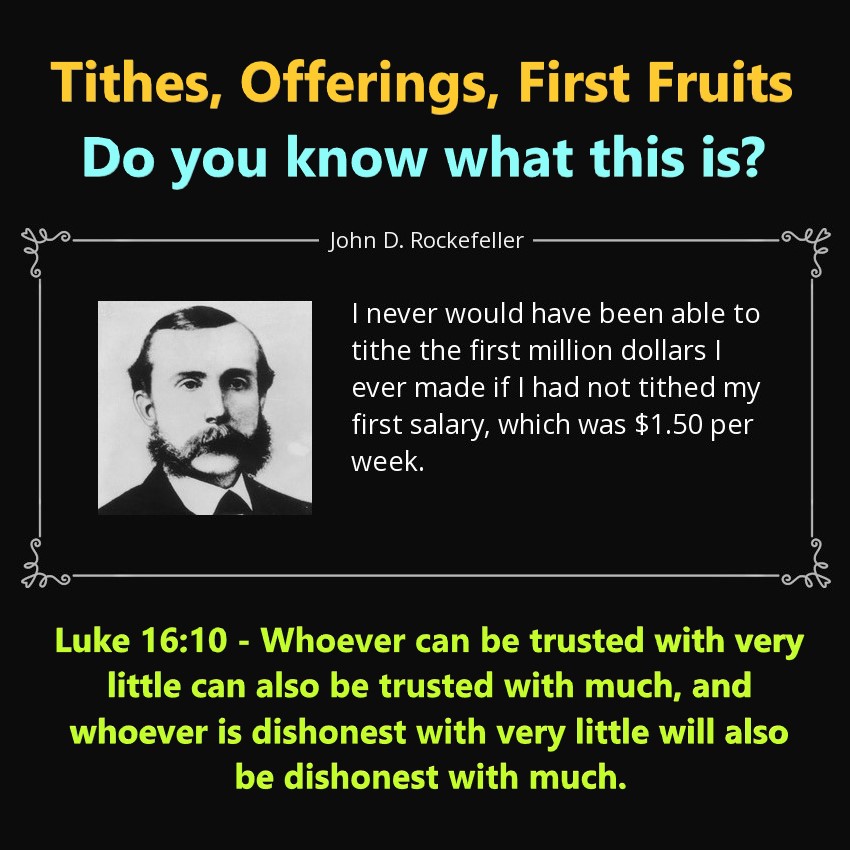
*Tithes, Offerings, First Fruits* — Do you know what this is?
Tithes and Offerings are actually two separate things and are NOT synonyms. First Fruits are also part of Tithing, that is often overlooked and not discussed.
*Tithe* — Exactly 10% of your monthly income, that is to be given to your home Church (wherever you are fed spiritually). A Tithe is not meant to be given to the homeless person you see on the street, or an online Ministry/Church you watch once in a while — this is where an Offering comes into play.
*First Fruits* — When you tithe, you are to take the first portion of your paycheck and “SET IT ASIDE” as Tithe, to be given to your church as soon as reasonably/possible. What that means is you DO NOT cash your check and go buy groceries, pay your mortgage, make a car payment, pay your credit cards, and then Lastly give tithe to your church. Because in this scenario, your Tithe is a *LAST* Fruit, instead of being a *FIRST* Fruit. However, it does not mean you have to wait to eat until you make it to Church. Here is how this works practically. If you tithe electronically, then, as soon as your paycheck hits your bank account, you are to log in and make an electronic payment to your Church. If you use a check or cash to Tithe, when you’re physically at the Church, you need to Mentally set the Tithe aside. There is a saying “it’s the thought that counts”. Well, when you are mentally setting the Tithe aside and saying, “ok, next time I’m at Church, I will give this much money as Tithe”, you are telling God, that you have prepared the First Fruits for God and have set it aside until you are physically in Church, and can drop it off.
*Offering* — This is any amount above and beyond the 10% Tithe. The Offering can be given anywhere there is a need. This can be a Church you visit as a guest, in another town. It can be an online Ministry you follow. It can be a homeless person on the street. Etc.
_Proverbs 3:9–10 — Honor the Lord with your wealth and with the *First Fruits* of all your produce; then your barns will be filled with plenty, and your vats will be bursting with wine._
*Offering Bible Verses:*
_Luke 6:38 ERV — Give to others, and you will receive. You will be given much. It will be poured into your hands — more than you can hold. You will be given so much that it will spill into your lap (bosom). The way you give to others is the way God will give to you._
_2 Corinthians 9:6–11 — Remember this: Whoever sows sparingly will also reap sparingly, and whoever sows generously will also reap generously. Each of you should give what you have decided in your heart to give, not reluctantly or under compulsion, for God loves a cheerful giver. And God is able to bless you abundantly, so that in all things at all times, having all that you need, you will abound in every good work._
*Tithe Bible Verses:*
_Malachi 3:8 — Will a man rob God? Yet ye have robbed me. But ye say, Wherein have we robbed thee? In Tithes and Offerings._
Pastor Robert Morris does a great job explaining Malachi 3:8. It does not literally refer to robbing God of money. This verse is saying that we are robbing God of His ability to bless us. God wants to bless us, but when we don’t tithe, we basically tie God’s hands and not allow Him to bless us. So God gave us the ability to tithe and give offerings, in order that He can bless us. Many people who are against tithing and offerings bring up the fact that this was part of the Law in the Old Testament. But we were all saved by Grace through Faith, so we no longer have to follow the Law. But they forget that Tithing and Offerings were practiced way before the Law. Cain, Abel, Abraham, Jacob gave Tithes/Offerings. Also, 2 Corinthians 9:7 says that God loves a cheerful giver, not one that gives reluctantly or under compulsion. God does not want people giving because they feel like they are being forced to give. So Tithing/Offering is more of a Gift to us, than a Requirement.
_Luke 16:10 — Whoever can be trusted with very little can also be trusted with much, and whoever is dishonest with very little will also be dishonest with much._
_Malachi 3:10–11 — Bring ye all the tithes into the storehouse, that there may be meat in mine house, and prove me now herewith, saith the Lord of hosts, if I will not open you the windows of heaven, and pour you out a blessing, that there shall not be room enough to receive it. And I will rebuke the devourer for your sakes, and he shall not destroy the fruits of your ground; neither shall your vine cast her fruit before the time in the field, saith the Lord of hosts. And all nations shall call you blessed: for ye shall be a delightsome land, saith the Lord of Hosts._
Prophet Robin D. Bullock does a great job explaining Malachi 3:10–11, which refers to having God keep satan off your back (rebuke the devourer). Basically when satan wants to mess with your finances, your tithe is your protection from satan and what tells satan he’s not allowed to. Because when you get 100% of money and you give 10% to God, it means that you’re acknowledging to satan that 100% of this money is God’s (none of it is yours). At which point he knows he’s not allowed to touch the remaining 90% because that is God’s as well — that God entrusted to you. But people that don’t tithe, are saying none of that money is God’s — it’s all theirs. So satan says, ok, I can’t touch God’s money, but i can touch man’s (your) money.
*Cain and Abel offering:*
Most of you have heard the story of Cain (Farmer) and Abel (Shepherd). These were sons of Adam and Eve. Each of the brothers brought an offering to God. God accepted Abel’s offering but did NOT accept Cain’s offering. The reason for this is because Abel showed respect and brought to God the *FIRSTBORN* of his flock and the *BEST* parts of the animal as an Offering. But Cain did not show respect, and *at some point* (took his time) brought *SOME* (not the best ones) of the fruits he gathered, as an offering to God (basically a slap in God’s face).
*Cain (Farmer)* — after a while (ISV) / *in the course of time* (NIV), Cain brought *SOME* of the fruits as an offering. — God *did NOT accept* this offering.
*Abel (Shepherd)* — brought *BEST* parts of his *FIRSTBORN* from his flock — God *accepted* this offering.
_Genesis 4:2–5 NIV — Now Abel kept flocks, and Cain worked the soil. In the course of time Cain brought some of the fruits of the soil as an offering to the Lord. And Abel also brought an offering — fat portions from some of the firstborn of his flock. The Lord looked with favor on Abel and his offering, but on Cain and his offering he did not look with favor. So Cain was very angry, and his face was downcast._
_Genesis 4:2–5 ISV — Abel shepherded flocks and Cain became a farmer. Later, after a while, Cain brought an offering to the Lord from the fruit that he had harvested, while Abel brought the best parts of some of the firstborn from his flock. The Lord looked favorably upon Abel and his offering, but he did not look favorably upon Cain and his offering._
*Tithing before the Law:*
*Abraham Tithed before it became the Law:*
_Genesis 14:16–20 — So he brought back all the goods, and also brought back his brother Lot and his goods, as well as the women and the people. And the king of Sodom went out to meet him at the Valley of Shaveh (that is, the King’s Valley), after his return from the defeat of Chedorlaomer and the kings who were with him. Then Melchizedek king of Salem brought out bread and wine; he was the priest of God Most High. And he blessed him and said: “Blessed be Abram of God Most High, Possessor of heaven and earth; And blessed be God Most High, Who has delivered your enemies into your hand.” *And he [Abram] gave him a Tithe of all*._
*Jacob Tithed before it became the Law:*
_Genesis 28:20–22 — Then Jacob made a vow, saying, “If God will be with me, and keep me in this way that I am going, and give me bread to eat and clothing to put on, so that I come back to my father’s house in peace, then the Lord shall be my God. And this stone which I have set as a pillar shall be God’s house, and *of all that You give me I will surely give a Tenth to You*._
*Jacob and Esau and selling Firstborn Birthright for a bowl of soup*
_Genesis 25:29–34 ERV — One day Esau came back from hunting. He was tired and weak from hunger. Jacob was boiling a pot of beans. So Esau said to Jacob, “I am weak with hunger. Let me have some of that red soup.” But Jacob said, “You must sell me your rights as the firstborn son.” Esau said, “I am almost dead with hunger, so what good are these rights to me now?” But Jacob said, “First, promise me that you will give them to me.” So Esau made an oath to him and sold his rights as the firstborn son to Jacob. Then Jacob gave Esau bread and lentil soup. Esau ate the food, had something to drink, and then left. So Esau showed that he did not care about his rights as the firstborn son._
In this Bible verse, Esau sells his birthright to his brother Jacob, and loses his claim on the family property. Specifically, Esau trades his birthright for Jacob’s freshly made soup when Esau is hungry. We often hear from people that they don’t have money left over for tithing because they had to pay their bills, go eat at a restaurant, pay their cable bill, etc. So let me ask you a question. If Tithing and Offering produces God’s Blessing for us, are we giving up God’s Blessing for one trip to a restaurant (a bowl of soup), or maybe we’re trading in God’s Blessing for a Movie/TV show (cable bill). So If you were to equate this coming Great Wealth Transfer (worth millions of dollars) to God’s Blessing, are those people trading in millions of dollars for a visit to a restaurant or a few movies on TV, because they can’t afford (don’t want to) tithe and give offerings?
I also made a YouTube Community Post where I listed various Eligibility Criteria for receiving the Great Wealth Transfer. One of the criteria was Tithes and Offerings. In this post I would like to discuss “Tithes, Offerings, and First Fruits” in more detail, and break it down for everyone.
https://www.youtube.com/post/Ugkx7V9a_kbx2WxWbaX5EftDlgbCp8t7fM5G

Malachi 3:8 says that a man robbed God of two things — 1) Tithes and 2) Offerings. Since Tithe of 10% was part of the old testament law, it makes sense how not giving it, robs God. But what about the Offering? An Offering is voluntary. So why does the Bible use the word “Rob/steal” for something that is mandatory and also something that is voluntary, in the same sentence? And how can a person rob God of something that is voluntarily given. It means that people are robbing God of the ability to bless them. God wants to bless his people, but in order to do that, he needs people to Tithe and to do Offerings. A Tithe will prevent satan from stealing your money (Malachi 3:10). An Offering will allow God to multiply your money so it grows. That is what 2 Corinthians 9:6 says — that whomever sows (their Offering) sparingly, will also reap sparingly. But whomever sows a Generous Offering, will reap generously. Luke 6:38 says that if you give away money (offering) to others (needy), God will give you so much that you won’t even be able to hold it all.
_Malachi 3:8 — Will a man rob God? Yet ye have robbed me. But ye say, Wherein have we robbed thee? In Tithes and Offerings._
_Malachi 3:10–11 — Bring ye all the tithes into the storehouse, that there may be meat in mine house, and prove me now herewith, saith the Lord of hosts, if I will not open you the windows of heaven, and pour you out a blessing, that there shall not be room enough to receive it. And I will rebuke the devourer for your sakes, and he shall not destroy the fruits of your ground; neither shall your vine cast her fruit before the time in the field, saith the Lord of hosts. And all nations shall call you blessed: for ye shall be a delightsome land, saith the Lord of Hosts._
_Luke 6:38 ERV — Give to others, and you will receive. You will be given much. It will be poured into your hands — more than you can hold. You will be given so much that it will spill into your lap (bosom). The way you give to others is the way God will give to you._
_2 Corinthians 9:6–11 — Remember this: Whoever sows sparingly will also reap sparingly, and whoever sows generously will also reap generously. Each of you should give what you have decided in your heart to give, not reluctantly or under compulsion, for God loves a cheerful giver. And God is able to bless you abundantly, so that in all things at all times, having all that you need, you will abound in every good work._
Luke 6:10 discusses Tithing. If God cannot trust you with giving Him 10% of your paycheck, how can He trust you with the millions of dollars coming from the great wealth transfer.
_Luke 16:10 — Whoever can be trusted with very little can also be trusted with much, and whoever is dishonest with very little will also be dishonest with much._
Proverbs 3:9 discusses First Fruits, which represent the first portion of everything you receive. In the story of Cain and Abel, Abel brought of his First Born of his flock (which is same as First Fruits). However, Cain brought “Some of the Fruits”. The Bible clearly shows the word “Some” instead of “First”. So that means Cain gathered his fruits, ate most of them, and whatever was left over, he went and gave to God. And this is why God was upset with Cain, because he disrespected him. This also applies to us. When we receive a paycheck from our jobs, we are to give the first part of our paycheck (before we spend anything) to God, and not whatever is left over after we’re doing paying bills. Because when people bring leftovers to Church, this really offends God in a big way.
_Proverbs 3:9–10 — Honor the Lord with your wealth and with the *First Fruits* of all your produce; then your barns will be filled with plenty, and your vats will be bursting with wine._
_Genesis 4:2–5 NIV — Now Abel kept flocks, and Cain worked the soil. In the course of time Cain brought some of the fruits of the soil as an offering to the Lord. And Abel also brought an offering — fat portions from some of the firstborn of his flock. The Lord looked with favor on Abel and his offering, but on Cain and his offering he did not look with favor. So Cain was very angry, and his face was downcast._
_Genesis 4:2–5 ISV — Abel shepherded flocks and Cain became a farmer. Later, after a while, Cain brought an offering to the Lord from the fruit that he had harvested, while Abel brought the best parts of some of the firstborn from his flock. The Lord looked favorably upon Abel and his offering, but he did not look favorably upon Cain and his offering._
And lastly, I want to bring up Mark 12:17. Some people think tithing was part of the law in the old testament, and because we were saved by Grace, we mostly only need to follow the new testament. This bible verse is from the new testament. In it, Jesus said to the Pharisees: pay the government (taxes) what you owe them, and pay God what you owe Him. As you see, God is not against taxation, and he did not change his mind about giving money to church.
_Mark 12:17 — And Jesus said to them, “Pay to Caesar the things that are Caesar’s, and to God the things that are God’s.” And they were utterly amazed at Him._
 Prophetic Money
[…] Tithing:Tithes, Offerings, First Fruits — Do you know what this is? — Prophetic Money
WordPress: https://propheticmoney.com/tithes-offerings-first-fruits-do-you-know-what-this-is-prophetic-money/
YT post: […]