

Do you know the Difference between a 12 or 24 Word Backup/Recovery/Seed Phrase and Private/Public Keys?
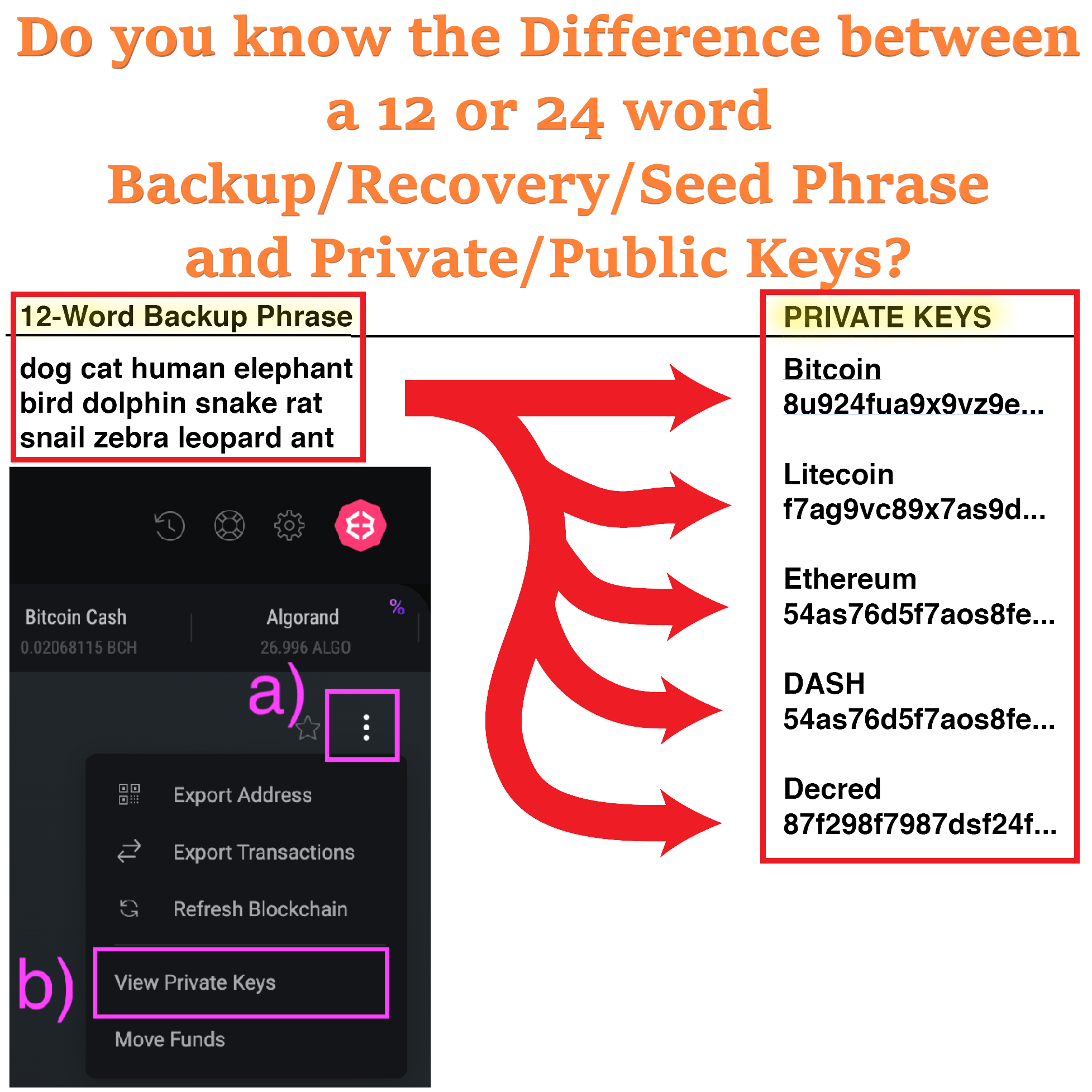
12 / 24 Word Backup/Recovery/Seed Phrase — Most crypto wallets automatically generate a seed phrase during set up. You need to store your seed phrase in a secret place. You will use it to recover your crypto wallet if it’s ever lost or stolen. Since your secret recovery phrase is your “master” private key, it gives access to all your private keys (XRP, BTC, ETH, etc) and their addresses with your funds. Your private keys can usually be found in your crypto wallet settings. Your crypto wallet maintains your private keys and uses them to authorize your transactions.
Public Key — A public key allows you to receive cryptocurrency transactions. It’s a cryptographic code that’s paired to a private key. Think of a public key as a bank account number; you can share this with anyone who wants to send you money. However, if you wish to access your own money, you’d need a PIN, which is your private key.
Private Key — Every address (XRP, BTC, ETH, etc.) that you create, or own, has its own private key. Private keys in the context of blockchain assets prove ownership of assets associated with a particular wallet address and allow you to access and spend the assets in that address.
Anyone that has access to either your “seed phrase” or your “private key” can steal your crypto.
Please note that not all wallets use the same method of address creation, so seed phrases are not truly universal. What this means is you typically cannot take a 24 word seed phrase from one wallet like Ledger and put it into another wallet like Exodus, to access your crypto. However, if you take your public and private key (for XRP, BTC, ETH, etc.) from your Ledger, you can import that public/private key into any other wallet like Exodus, Trezor, etc. So your public/private key is universal between all wallets, but the seed phrase may or may not be. This also means if you are using a crypto wallet that stops functioning, you may or may not be able to recover your crypto, if all you have is a seed phrase. But if you have your private keys saved, you can just import those keys into any other wallet to access your crypto.
I’m not sharing this to scare you, but to make sure you fully understand the mechanics of a crypto wallet. Since many people ask what happens if Binance exchange goes bankrupt and shuts down; but they own Trust Wallet. In theory, the Trust Wallet app could eventually stop functioning, because, there is no company left to maintain/update it. So you would need to have your private keys in order to access your crypto on another wallet. This is not something we have to worry about right now, but to just keep in mind.
See below instructions for obtaining you private keys from Trust Wallet if it ever stops working. Trust Wallet doesn’t let you see your private keys (they are encrypted and hidden). So special software has to be used to extract the private keys from the seed phrase. I wouldn’t recommend doing this, unless you have no other choice.
________________________________________________________________________
What Happens to my Funds if Trust Wallet Closes?
Just so you know, crypto doesn’t live inside of a wallet (whether it’s ledger or trust wallet). Only your keys live there. This means your 12 word passphrase to open the wallet gives you access to all your cryptos and their individual private keys – each crypto (xrp, volt, shib, etc.) has its own unique private key that you can use to access that crypto from any wallet.
Exodus Wallet and Atomic Wallet have an option that lets you see the private key for each of your cryptos. But Trust Wallet does not. So someone out there built a tool that allows you to put in your 12 word passphrase (that you should never reveal to anyone), and the tool converts that passphrase and shows you the passkeys for each crypto. The problem is, we don’t know if we can trust the builder of the tool. What if he has an evil code programmed in the tool to steal your passphrase and then steal your crypto? Since many youtubers and online crypto articles have mentioned this tool, it may be safe to use. But even so, I am still skeptical, and would not use it unless I ran out of all other options.
That said, if trust wallet stops working and we have not moved our crypto in time, we should be able to use this guide to convert our 12 word passphrase to get our private keys, to then import them into a different wallet, and then quickly transfer the crypto to a different address.
Here is a tutorial for extracting your private keys from your trust wallet 12 word passphrase. Don’t do this unless trust wallet stops working or shuts down …and you really have to.
https://crypt0jan.medium.com/trust-wallet-mnemonic-to-private-key-4c72714fda0e
https://isitcrypto.com/get-trust-wallet-private-key/
Trust Wallet Private Key: Step-by-Step to Get It
https://archive.ph/Fr9gm
https://iancoleman.io/
https://github.com/iancoleman/bip39
_________________________________________________________________________
See links below for the information I shared in the post above.
https://getcoinplate.com/blog/seed-phrase-vs-private-key/?v=0b3b97fa6688
https://worldcoin.org/articles/what-is-seed-phrase
https://www.exodus.com/support/article/148-what-are-private-keys#store
https://www.exodus.com/support/article/86-how-can-i-view-my-private-keys#2
 Prophetic Money